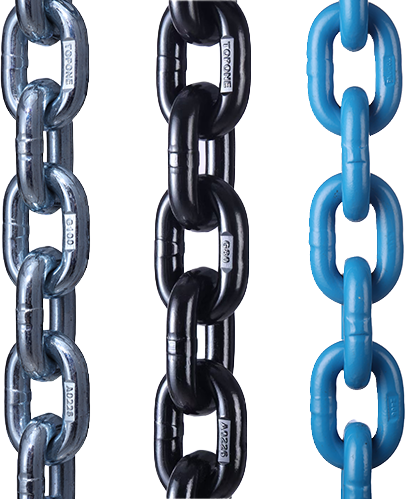
When you lift a heavy load with a Grade 80 or Grade 100 chain, you are relying on one of the most critical manufacturing processes in metallurgy: chain heat treatment. Without this essential step, even the highest-quality alloy steel would lack the strength, toughness, and wear resistance required for safe overhead lifting.
But what exactly happens during chain heat treatment? Why is the combination of quenching and tempering so vital to lifting chain performance? And how does the science behind these processes determine whether a chain can safely handle its rated load—or fail catastrophically?
This article explores the metallurgical science behind chain heat treatment, explaining why quenching and tempering are essential for producing the high-strength lifting chains that industry depends on.
What Is Chain Heat Treatment?
Chain heat treatment is a controlled process of heating and cooling metal to alter its physical and mechanical properties. The goal is to achieve the optimal balance of strength, hardness, toughness, and wear resistance required for the chain's intended application.
For high-strength lifting chains—such as Grade 80 and Grade 100—heat treatment is not optional. It is a mandatory requirement specified by international standards. According to ASTM A391/A391M, the standard specification for Grade 80 alloy steel chain, "the material shall be heat treated which includes quenching and tempering" . Similarly, ASTM A973/A973M for Grade 100 chain requires the same quenching and tempering process.
The heat treatment process fundamentally changes the microstructure of the steel. All metals consist of specific microstructures—arrangements of molecules that determine their properties. When heated, the molecules shift positions. When rapidly cooled (quenched), they lock into a new microstructure with significantly increased hardness and strength.
Austenitization – Preparing the Steel for Transformation
The first stage of chain heat treatment is austenitization. The chain is heated to a temperature above its critical range—typically between 800°C and 1000°C.
At these elevated temperatures, the steel's microstructure transforms into austenite, a face-centered cubic crystalline structure that can dissolve more carbon. This transformation is essential because it prepares the steel for the next critical step: quenching.
Why Austenitization Matters:
Carbon dissolution: At high temperatures, carbon atoms dissolve more readily into the iron lattice
Grain refinement: Proper heating creates a fine austenitic grain structure, which contributes to strength
Uniformity: Controlled heating ensures consistent temperature throughout every link
The chain must be heated uniformly—every link must reach the same temperature to ensure consistent properties throughout the entire length.
Quenching – Creating Hardness
Quenching is the most dramatic step in the chain heat treatment process. The austenitized chain is rapidly cooled by immersion in a quenching medium—typically water, oil, or a polymer solution.
During quenching, the chain is cooled from approximately 870°C to 930°C (1600°F to 1700°F) down to ambient temperature in a matter of seconds.
The Science Behind Quenching:
The rapid cooling prevents the steel from transforming back into its softer, equilibrium structures (such as pearlite or ferrite). Instead, the carbon atoms become trapped in the crystal lattice, creating a new microstructure called martensite.
Martensite is an extremely hard, brittle phase of steel. It is characterized by:
High hardness: Up to 60-65 HRC or higher
High strength: Significantly increased tensile strength
Low ductility: The material becomes brittle and less able to deform without fracturing
Quenching achieves high hardness and strength by rapidly cooling the high-temperature austenitic structure into a high-hardness martensitic structure. This transformation is what gives lifting chains their ability to withstand heavy loads without deforming.
Quenching Media:
Medium | Cooling Rate | Best For |
Water | Fastest | Larger chains, higher hardenability |
Oil | Moderate | Smaller chains, reduced distortion risk |
Polymer | Controlled | Precision applications |
However, as-quenched martensite has a critical weakness: it is extremely brittle. A chain in this state would be hard but prone to catastrophic fracture under impact or dynamic loading. This is why quenching alone is never sufficient for lifting chain production.
Tempering – Restoring Toughness
Tempering is the essential companion to quenching. Without tempering, the chain would be too brittle for safe use. This is why chain heat treatment always includes both quenching and tempering.
During tempering, the quenched chain is reheated to a lower temperature—typically between 400°F and 600°F (200°C to 315°C) —and then cooled again.
The Science Behind Tempering:
Tempering allows some of the trapped carbon atoms to diffuse out of the martensite structure. This relieves internal stresses and transforms the brittle martensite into tempered martensite—a microstructure that retains much of the hardness and strength of martensite while gaining significantly improved toughness and ductility.
The tempering process:
Relieves internal stresses created during quenching
Reduces brittleness while maintaining strength
Increases toughness – the ability to absorb energy without fracturing
Improves ductility – the ability to deform slightly before failure
The balance between strength and ductility in high-grade lifting chains is fundamentally governed by their heat treatment. Lower tempering temperatures preserve higher strength but result in lower ductility. Higher tempering temperatures increase ductility but reduce strength. Manufacturers must carefully control the tempering temperature to achieve the optimal balance for each chain grade.
The Strength-Toughness Trade-off:
Tempering Temperature | Strength | Toughness | Ductility |
Lower (400-500°F) | Higher | Lower | Lower |
Moderate (500-600°F) | Optimal | Optimal | Optimal |
Higher (600-700°F) | Lower | Higher | Higher |
For Grade 80 chains, the typical post-weld heat treatment (PWHT) temperature is 550-600°C with a hold time of 2-3 hours, producing tempered martensite with stress relief and approximately +10% improvement in impact toughness.
How Chain Heat Treatment Determines Chain Grades
The grade of a lifting chain—G80, G100, etc.—is directly determined by its tensile strength, which in turn is determined by its chain heat treatment and alloy composition.
Grade 80 Chains:
Base material: Medium-carbon steel with alloying elements including chromium, nickel, and molybdenum
Heat treatment: Quenching and tempering
Microstructure: Tempered martensite
Minimum tensile strength: 800 MPa
Chemical requirements: Conforms to ASTM A391/A391M specifications for carbon, phosphorus, sulfur, nickel, chromium, and molybdenum
The chain's grade is based on the nominal stress in the link at the design breaking force strength. It is calculated by taking the minimum breaking force load and dividing by two times the nominal cross-sectional area of the link.
Grade 100 Chains:
Base material: High-strength low-alloy (HSLA) steel
Heat treatment: Controlled quenching
Microstructure: Fine-grained bainite/martensite
Minimum tensile strength: 1,000 MPa
Standard: ASTM A973/A973M
Achieving a higher tensile strength (moving from G80 to G100) inherently involves metallurgical trade-offs that directly impact elongation and toughness. This is why precise control of the quenching and tempering process is essential.
Other Heat Treatment Methods for Chains
While quenching and tempering (through hardening) is the primary chain heat treatment method for lifting chains, other techniques may be used in specific applications.
Through Hardening
Through hardening is the complete process of heating, quenching, and tempering the entire chain. This process hardens and strengthens the material evenly throughout the entire section of the chain links. The outcome is tempered steel that is harder and stronger, but still has adequate ductility and toughness.
Carburizing (Case Hardening)
Carburizing is the process of hardening steel by exposing it to carbon while the metal is being heated. The addition of carbon to the surface changes the chemistry and makes it more responsive to heat treatment while maintaining a softer and more ductile core.
High-strength lifting chains (such as G80 and G100 grades) typically undergo heat treatment including carburizing and quenching to meet strength requirements.
The carbon is only absorbed at exposed surfaces, and the depth of penetration is proportional to the time in the furnace—hence the term "case hardened". Case hardening creates the potential for harder steel than other hardening methods.
Induction Hardening
Induction hardening is a process of heating and then quenching, but the application of heat is done in a controlled fashion through an induction process (strong magnetic fields). It is usually applied as a secondary process on top of through hardening.
Controlling the induction process limits the depth and pattern of the hardness change, allowing manufacturers to harden specific sections of a chain instead of the entire unit. Induction hardening can give several times greater wear life in non-abrasive environments.
What Happens If Heat Treatment Is Done Incorrectly?
Chain heat treatment requires precision and expertise. Errors at any stage can compromise chain safety and performance:
Insufficient Quenching:
Incomplete martensite formation
Lower than specified hardness
Reduced tensile strength
Chain may not meet grade requirements
Overheating During Austenitization:
Excessive grain growth
Reduced toughness
Increased risk of cracking
Inadequate Tempering:
Chain remains too brittle
Risk of sudden fracture under load
Potential for catastrophic failure
Over-Tempering:
Excessive loss of hardness
Reduced strength
Chain may not achieve required grade specifications
Skipping Tempering Altogether:
While achieving a target hardness through quenching-only heat treatment is technically possible, for chains that will experience any dynamic load, skipping the tempering step introduces significant risks of brittle failure and unpredictability.
How TOPONE CHAIN Performs Chain Heat Treatment
At TOPONE CHAIN, every Grade 80 and Grade 100 lifting chain undergoes precise quenching and tempering in accordance with international standards.
TOPONE's Heat Treatment Process:
Controlled atmosphere furnaces: Ensure uniform heating and consistent results
Precise temperature control: Every link reaches the correct austenitization temperature
Rapid quenching: Using optimized quenching media for maximum hardness
Carefully controlled tempering: Achieving the optimal balance of strength and toughness
Full testing and certification: Every chain is tested to verify heat treatment results
TOPONE CHAIN's lifting chains are manufactured and tested according to EN 818, ASTM A391/A391M, ASTM A973/A973M, NACM, and ASME B30.9 standards, ensuring that the chain heat treatment process meets the stringent requirements for overhead lifting applications.
Conclusion
Chain heat treatment—specifically the combination of quenching and tempering—is the critical manufacturing process that transforms ordinary alloy steel into the high-strength lifting chains that industry depends on.
Quenching creates the extreme hardness and strength by forming martensite
Tempering restores the toughness and ductility needed for safe, reliable lifting
Precise control of both processes is essential for achieving the required chain grade
Without proper chain heat treatment, even the highest-quality alloy steel cannot achieve the strength, toughness, and wear resistance required for overhead lifting. The science behind quenching and tempering is what makes Grade 80 and Grade 100 chains capable of safely handling the most demanding lifting applications.
When you choose a TOPONE CHAIN lifting chain, you are choosing a product that has been heat-treated with precision and expertise—delivering the strength, safety, and reliability that your operation demands.
About TOPONE CHAIN
Want to learn more about TOPONE CHAIN's heat treatment capabilities? Contact TOPONE CHAIN for more information about our Grade 80 and Grade 100 alloy steel lifting chains.
TOPONE CHAIN specializes in the manufacture of high-strength alloy steel lifting chains for overhead lifting, rigging, and heavy-duty material handling. All products undergo precise quenching and tempering and are tested according to EN 818, ASTM A391/A391M, ASTM A973/A973M, and ASME B30.9 standards, ensuring safety, reliability, and regulatory compliance.