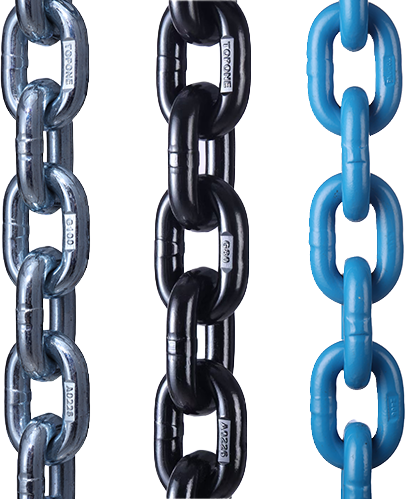
When selecting alloy steel chain for overhead lifting, Grade 80 and Grade 100 are two of the most common choices. They may look similar, but their strength ratings and Working Load Limits (WLL) are different.
The most important difference in a G80 vs G100 lifting chain comparison is that Grade 100 provides a higher rated capacity than Grade 80 at the same nominal chain diameter when compared within the applicable standardized product system.
In practical terms, Grade 100 can often provide the required lifting capacity with a smaller chain size than Grade 80. This can reduce the weight of a chain sling and make larger assemblies easier to handle.
However, this does not mean Grade 100 is automatically the better choice for every application. Chain grade, diameter, WLL, sling configuration, compatible components, working environment, and applicable standards all need to be considered together.
This guide explains the practical differences between G80 and G100 lifting chains and how to choose between them.
G80 vs G100 Lifting Chain: The Main Differences
Both Grade 80 and Grade 100 are high-strength alloy steel lifting chain grades used in chain slings and other lifting applications. The grade designation relates to the chain's strength class rather than its physical diameter.
This distinction matters because two chains can have exactly the same nominal diameter while carrying different rated loads.
The main differences can be summarized as follows:
Comparison | G80 Lifting Chain | G100 Lifting Chain |
Chain grade | Grade 80 | Grade 100 |
Nominal strength class | 800 N/mm² | 1,000 N/mm² |
WLL at same diameter | Lower | Higher |
Capacity-to-weight ratio | Standard | Higher |
Potential chain size for same load | Larger | Smaller |
Sling weight for comparable capacity | Generally higher | Can be lower |
Typical use | General industrial lifting | General and higher-capacity lifting |
Component requirement | Compatible G80 system | Compatible G100 system |
The nominal strength class helps explain why Grade 100 can provide more capacity from a comparable chain diameter. However, lifting chain should never be selected by tensile strength alone.
The manufacturer's WLL table for the actual chain, diameter, and sling configuration remains the basis for lifting selection.
Grade 80 has been widely used in industrial lifting for many years and remains a practical choice for machinery handling, construction, fabrication, maintenance, shipyards, and general rigging.
Grade 100 provides another option when higher capacity or reduced sling weight is desirable.
The choice therefore is not simply:
G80 = standard / G100 = better
A more useful comparison is:
G80 = proven general-purpose lifting solution
G100 = higher capacity-to-size option
Which one is appropriate depends on the lift.
How Much Stronger Is G100 Than G80?
This is usually the first question buyers ask when comparing G80 vs G100 lifting chain.
Based on the nominal grade strength classes, Grade 100 represents a 25% increase from Grade 80:
(1000 − 800) ÷ 800 × 100 = 25%
Within comparable standardized lifting-chain systems, this higher strength class generally allows Grade 100 chain to achieve approximately 25% higher WLL at the same nominal diameter than Grade 80.
However, “25% stronger” should not be treated as a universal shortcut for every sling assembly.
Actual WLL depends on:
Chain diameter · Number of legs · Sling angle · Hitch configuration · Components · Applicable rating system
For example, you should not take the WLL printed on an existing Grade 80 sling tag, multiply it by 1.25, and assume that this becomes the capacity after changing the chain to Grade 100.
The complete Grade 100 assembly must have its own rated capacity.
Same Diameter, Different Capacity
Suppose two lifting chains both have a nominal diameter of 10 mm.
One is Grade 80 and the other is Grade 100.
Although their physical size may appear similar, their strength grades are different. Therefore, their rated WLLs should be checked separately.
This is why a chain should always be identified using at least:
Grade + Diameter + Applicable WLL
rather than diameter alone.
For example:
10 mm G80 lifting chain
and
10 mm G100 lifting chain
are two different lifting specifications.
Same Capacity, Different Chain Size
The comparison can also be approached from the opposite direction.
If a particular lifting application requires a specified WLL, Grade 100 may allow the designer or manufacturer to achieve that capacity using a smaller nominal chain diameter than would be required with Grade 80.
This can become important in multi-leg chain slings.
A reduction in individual chain size can reduce the overall weight of a sling containing several legs, especially when the sling has a long reach.
However, the exact diameter must always be selected from the applicable manufacturer's load table rather than estimated from the 25% strength difference.
G80 vs G100 Chain Sling: Weight, Components and Handling
The advantage of Grade 100 becomes easier to understand when considering a complete chain sling, rather than an individual chain link.
Imagine a four-leg sling with several meters of chain in each leg. Increasing the chain diameter adds weight to every leg and may also require larger hooks, connecting links, and master-link arrangements.
If Grade 100 allows the required WLL to be achieved with a smaller chain size, the complete sling can potentially become lighter and easier to handle.
This can be useful where slings are frequently:
Carried manually
Connected to machinery
Positioned around large loads
Installed at height
Moved between work areas
Stored and transported between lifting operations
However, lighter does not automatically mean that Grade 100 should replace Grade 80 in every sling.
Components Must Match the Sling System
A chain sling is a complete assembly that may include:
Master Link → Connecting Components → Lifting Chain → Shortening Device → Hook
The capacity of the sling depends on the rated assembly, not only on the chain.
If Grade 100 chain is installed with an unsuitable or lower-rated component, the higher chain strength does not automatically increase the WLL of the sling.
Hooks, master links, connecting links, shortening devices, and other load-bearing components must be suitable for the intended Grade 100 configuration.
The same principle applies to Grade 80.
A useful rule is:
Never upgrade the chain and assume you have upgraded the sling.
The complete assembly needs to be evaluated and rated accordingly.
Can G100 Chain Be Used with G80 Components?
Do not assume that G80 and G100 components are interchangeable simply because they physically connect.
Compatibility should be verified using the component manufacturer's specifications and the applicable sling system requirements.
A component that fits dimensionally may still have a different grade, WLL, or approved connection method.
When replacing or assembling lifting components, verify the chain diameter, component grade, WLL, dimensions, connection method, and manufacturer's compatibility requirements.
How to Choose Between Grade 80 and Grade 100 Lifting Chain
The best choice depends on what you are trying to achieve with the lifting system.
Grade 80 remains suitable for a wide range of industrial lifting applications. If the required WLL can be achieved with a practical chain diameter and sling weight, there may be no operational reason to move to Grade 100.
Grade 100 becomes particularly useful when higher capacity is required without proportionally increasing chain diameter.
Consider the following comparison:
Selection Requirement | G80 | G100 |
General lifting | ✓ | ✓ |
Higher WLL at same nominal diameter |
| ✓ |
Reduce chain size for comparable capacity |
| ✓ |
Reduce weight of larger multi-leg slings | Possible | Often advantageous |
Existing compatible G80 sling system | ✓ | Check before changing |
New high-capacity sling design | ✓ | Often advantageous |
Choose G80 When
Grade 80 can be a practical choice when the required capacity is comfortably covered by an available chain size and the resulting sling weight is acceptable.
It is also useful when the existing lifting system, replacement components, and site procedures are already based around compatible Grade 80 equipment.
There is little benefit in selecting a higher grade purely because the number is larger if Grade 80 already meets the actual lifting requirement efficiently.
Choose G100 When
Grade 100 becomes attractive when capacity-to-weight ratio matters.
For example, a heavy multi-leg sling can become difficult for workers to position manually. If an appropriate Grade 100 configuration achieves the required WLL with a smaller chain diameter, reducing sling weight can improve handling.
It can also be useful where space around hooks, lifting points, or rigging components makes excessive chain size undesirable.
But Grade 100 should still be selected by rated WLL and complete system compatibility, not by grade designation alone.
Standards, Identification and Inspection
Both G80 and G100 lifting chains should be manufactured and rated according to standards applicable to their intended market and application.
For European lifting-chain systems, relevant standards include the EN 818 series, with requirements covering short-link lifting chains and chain sling assemblies. Other markets may use different standards and regulatory requirements.
When purchasing lifting chain, verify the applicable product standard rather than relying only on a supplier's statement that a chain is “G80” or “G100.”
Proper identification and traceability are also important.
Depending on the applicable requirements and product configuration, information may include:
Chain grade · Chain diameter · Manufacturer identification · WLL · Sling identification · Traceability information
The markings used for Grade 80 and Grade 100 should allow the chain or complete sling to be correctly identified during service.
Inspection Requirements Are Still Essential
Higher strength does not make Grade 100 immune to wear or damage.
Both G80 and G100 chains require appropriate inspection throughout their service life.
Inspection should consider conditions such as:
Wear
Elongation
Bent or twisted links
Cracks
Gouges or severe nicks
Heat damage
Corrosion
Damaged weld areas
Deformed hooks or components
Missing or illegible identification
A Grade 100 chain that has exceeded its allowable wear or damage limits is not safer than a correctly maintained Grade 80 chain.
The manufacturer's inspection and removal criteria should therefore always be followed.
Working environment also matters. High temperatures, chemical exposure, corrosive conditions, and other severe environments can affect the suitability of alloy steel lifting chains. Confirm the manufacturer's limitations before using either grade under unusual conditions.
G80 or G100: Which Lifting Chain Should You Choose?
The decision becomes easier when you stop treating chain grade as an isolated specification.
Start with the lifting requirement.
Determine the maximum load, sling configuration, number of legs, sling angle, required reach, and working environment. Then establish the required WLL and compare the available Grade 80 and Grade 100 configurations.
A practical selection sequence is:
Maximum Load → Sling Configuration → Sling Angle → Required WLL → Compare G80 and G100 → Select Diameter → Verify Components
If Grade 80 provides the required WLL at a practical diameter and sling weight, it remains a suitable solution.
If the application benefits from a higher WLL at the same diameter—or a smaller and potentially lighter chain for comparable capacity—Grade 100 may provide a practical advantage.
The most important differences can be summarized simply:
G80: established high-strength lifting chain for general industrial applications.
G100: higher strength class that can provide approximately 25% higher rated capacity at the same nominal diameter within comparable standardized systems.
Neither grade should be selected from strength class alone. The final decision should always be based on the rated WLL of the complete lifting configuration.
For buyers, that is the distinction that matters most: the better chain is not necessarily the one with the higher grade number—it is the one that provides the required capacity, dimensions, compatibility, and handling characteristics for the actual lift.