X
Our staff will contact you within 12 hours, You can also contact us through the following ways:
Contact US WhatsApp: +8618766656705
- Email: [email protected]
- Tel: +8618766656705
- Web: https://www.toponechain.com/
Introduction
Raw Material Inspection and Selection
Cutting the Steel Rod
Forming the Chain Links
Electric Flash Butt Welding
Calibration (First Proofreading)
Heat Treatment (Quenching and Tempering)
Calibration (Second Proofreading) and Proof Testing
Bow Test (Long-Length Consistency Check)
Cutting to Customer Specifications
Surface Treatment
Final Inspection and Quality Control
Packaging and Warehousing
How TOPONE CHAIN Manufactures Lifting Chains
Conclusion
A complete guide to the manufacturing process of high-strength alloy steel lifting chains
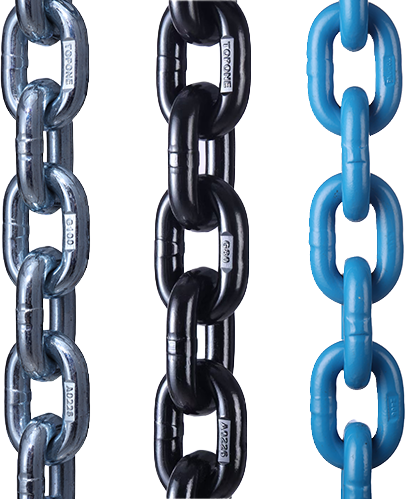
When you lift a heavy load with a Grade 80 or Grade 100 chain, you're placing your trust—and your safety—in a product that has undergone a complex, multi-stage manufacturing process. From raw steel rod to finished, tested, and certified chain, each step is critical to ensuring the final product meets the stringent safety and performance standards required for overhead lifting.
Understanding how lifting chains are manufactured not only helps you appreciate the engineering behind these essential tools but also enables you to make more informed purchasing decisions. This guide walks you through the complete lifting chain manufacturing process—from raw material inspection to final packaging—explaining what happens at each stage and why it matters.
The lifting chain manufacturing process begins with the most fundamental element: the raw material. High-quality lifting chains start with high-quality steel.
For Grade 80 and Grade 100 alloy steel chains, manufacturers use premium alloy steel containing specific amounts of chromium (Cr), nickel (Ni), and molybdenum (Mo) . These alloying elements are essential for achieving the strength, toughness, and wear resistance required for overhead lifting applications.
Incoming material inspection: When raw steel coils or rods arrive at the factory, samples are cut for testing
Chemical analysis: Spectral testing verifies that the chemical composition meets the required specifications for the target chain grade
Hardness testing: Samples are tested to ensure consistent material properties
Visual inspection: Workers examine the raw material for surface defects
Why It Matters: The chemical composition of the steel directly determines the chain's final mechanical properties. Chains made from substandard materials cannot achieve the required strength or heat treatment response, regardless of how carefully they are processed later.
Standards Reference: Grade 80 chains must conform to ASTM A391/A391M, which specifies chemical requirements for carbon, phosphorus, sulfur, nickel, chromium, and molybdenum. Grade 100 chains are governed by ASTM A973/A973M.
Once the raw material is approved, the steel rod or wire is prepared for the forming process.
The steel is cleaned and drawn to the exact wire diameter required for the specific chain size. It is then cut into precise lengths—each piece will become one link of the chain.
Diameter consistency: The wire diameter must be uniform to ensure consistent chain strength
Length precision: Each cut piece must be the correct length to form a link of the specified dimensions
Surface quality: The cut surfaces must be clean and free from defects that could affect welding
The cut pieces are then stored and fed into the chain-making equipment as needed.
This is where individual links begin to take shape. The cut steel pieces are fed into a chain-forming machine that bends them into the characteristic oval or round shape of a chain link.
The cut steel piece is heated (in some processes) or cold-formed into a "U" shape
The piece is bent around a former to create the link's final shape
The link is interlocked with the previously formed link, creating a continuous chain
The ends of the link are brought together for welding
Full automatic equipment in chain production produces superior results compared to semi-automatic equipment or manual welding. Automated systems ensure consistent link geometry, precise dimensions, and repeatable quality.
Pitch accuracy: The distance between links must be consistent
Outside width: Each link must meet dimensional specifications
Interface clearance: The gap where the link ends meet must be within tolerance
Welding is one of the most critical stages in the lifting chain manufacturing process. The quality of the weld directly determines the chain's strength and safety.
Most high-quality lifting chains use electric flash butt welding—a sophisticated welding process that joins the ends of each link without adding any filler material.
The two ends of the formed link are brought together
An electric current is passed through the ends, heating them
The ends are pressed together under high pressure, forging them into a solid joint
Excess material (flash) is trimmed away
Advanced techniques such as pulsed flash butt welding have been developed specifically for producing high-strength chain, allowing for consistent weld quality across large production runs.
Full penetration: The weld must extend through the entire cross-section of the link
No defects: The weld area must be free from cracks, glitches, or scratches
Smooth surface: The welded area should be as smooth as the rest of the link
Quality Verification: Samples of welded chain are cut from the production run several times per shift and tested to verify weld integrity.
After welding, the chain undergoes its first calibration or proofreading process.
Dimensional consistency: Ensures each link meets the specified dimensions
Link alignment: Corrects any minor distortions from the welding process
Strength verification: The calibration process also tests the strength of the chain, particularly at the welded sections
During this stage, the chain may also receive identification markings—such as the grade and traceability codes—stamped into the links. These markings are essential for traceability and regulatory compliance.
Heat treatment is the core of the lifting chain manufacturing process—the stage that transforms ordinary steel into a high-strength alloy lifting chain.
For Grade 80 and Grade 100 chains, heat treatment involves two key processes: quenching and tempering.
The chain is heated to a very high temperature—typically between 1600°F and 1700°F (870°C to 927°C) —and then rapidly cooled in water or oil. This process:
Increases hardness dramatically
Transforms the steel's microstructure to a martensitic structure
Significantly increases tensile strength
After quenching, the chain is reheated to a lower temperature—typically 400°F to 600°F (200°C to 315°C) —and then cooled. This process:
Reduces brittleness caused by quenching
Relieves internal stresses
Increases toughness while maintaining high strength
Surface hardness testing: Verifies that the heat treatment achieved the required hardness
Breaking tension testing: Confirms the chain meets minimum breaking force requirements
Extension force testing: Checks elongation characteristics
Why Heat Treatment Matters: The heat treatment process is what gives Grade 80 and Grade 100 chains their superior strength-to-weight ratio and resistance to wear and fatigue. Without proper heat treatment, even the best alloy steel cannot achieve the performance required for overhead lifting.
After heat treatment, the chain undergoes a second calibration (or proofreading) process.
The chain is stretched under controlled tension
Typically, 5 to 7 links are calibrated at a time
The tension applied is greater than 2.5 times the rated load
Proof testing is a critical quality control step in the lifting chain manufacturing process. It involves applying a tensile force to the chain that is higher than the working load but lower than the breaking load.
The proof test force is typically twice the Working Load Limit (WLL)
The test is applied under constantly increasing force in direct tension
The purpose is to:
Eliminate residual stresses from manufacturing
Detect any hidden defects
"Shape" the chain to ensure consistent performance
Automatic proof testing is standard in modern chain manufacturing facilities.
For longer chain lengths, a bow test may be performed.
A length of chain (typically 6 meters) is pulled with 2.5 times the rated load
The test checks the consistency of the entire length of chain
It can reveal any variations in heat treatment or manufacturing quality along the chain
This test is particularly important for chains that will be used in long lengths, such as those used in hoists or conveyor systems.
At this stage, the chain is cut to the specific lengths required by customers—such as 6 meters, 10 meters, 20 meters, or custom sizes.
A chain breaking test is performed on samples
The cut ends are inspected for any damage
Length accuracy is verified
After cutting, the chain undergoes surface treatment based on customer requirements and the intended application environment.
| Treatment | Description | Best For |
|---|---|---|
| Polishing | Smooths the surface, removes scale | General applications, aesthetic requirements |
| Blackening | Creates a black oxide coating | Moderate corrosion protection, cost-effective |
| Galvanizing | Zinc coating applied by hot-dip or electroplating | High corrosion environments, outdoor use |
| Electrophoresis | Paint coating applied electrically | Uniform coverage, corrosion resistance |
| Dacromet | Zinc-aluminum coating with excellent corrosion resistance | Severe corrosion environments |
| Oiling | Protective oil film applied | Temporary protection during storage/transport |
Prevent rust and corrosion
Extend service life
Improve appearance
Provide additional wear resistance
Customers should choose the appropriate surface treatment based on their specific use environment.
Before any chain can be shipped, it must pass a comprehensive final inspection.
| Test | Purpose |
|---|---|
| Hardness test | Verifies heat treatment results |
| Tension test | Confirms strength meets specifications |
| Breaking test | Validates minimum breaking force |
| Elongation test | Checks ductility and toughness |
| Dimensional inspection | Verifies all dimensions meet specifications |
| Visual inspection | Checks for surface defects |
Non-destructive testing (NDT) —such as magnetic particle inspection—may also be performed to detect surface and near-surface cracks that are not visible to the naked eye.
Each test result is recorded for traceability and quality records.
After passing final inspection, the chain is ready for packaging and warehousing.
Tons bags: For bulk quantities
Wooden cases: For export or high-value orders
Iron drums: For heavy or large quantities
Plastic drums: For smaller quantities or corrosion-sensitive applications
Proper packaging protects the chain during transport and storage, preventing damage and corrosion.
High-quality lifting chains are manufactured and tested according to international safety standards that specify everything from material composition to testing procedures.
| Standard | Scope |
|---|---|
| EN 818 | European standard for short-link chain slings |
| ASTM A391/A391M | Standard Specification for Grade 80 Alloy Steel Chain |
| ASTM A973/A973M | Standard Specification for Grade 100 Alloy Steel Chain |
| NACM 96/84 | National Association of Chain Manufacturers' specifications |
| ASME B30.9 | Safety standard for slings |
Alloy steel chain shall be manufactured and tested in accordance with these standards. Chains that meet these standards are marked with the grade, WLL, manufacturer ID, and batch traceability information.
At TOPONE CHAIN, we follow a rigorous lifting chain manufacturing process that ensures every chain meets the highest standards of quality and safety.
Premium raw materials: Alloy steel containing chromium, nickel, and molybdenum
Quenched and tempered heat treatment: Applied to every Grade 80 and Grade 100 chain
Full testing and certification: Every chain is tested according to EN 818, NACM, and ASME B30.9 standards
4:1 safety factor: All chains are designed with a 4:1 safety factor
2.5 times proof load: Each chain is proof tested to 2.5 times its WLL
Complete traceability: Every chain is marked and documented
TOPONE CHAIN's factory began large-scale production of Grade 80 and Grade 100 high tensile lifting chains according to EN818-2, ASTM80, NACM96, and Australian standards. Today, TOPONE delivers certified alloy sling chain solutions that meet the stringent safety requirements of the world's most demanding industries.
The lifting chain manufacturing process is a complex, multi-stage operation that transforms raw alloy steel into a precision-engineered safety product. From material inspection and forming to welding, heat treatment, proof testing, and final inspection, every step is critical to ensuring the chain's strength, durability, and safety.
Understanding this process helps you appreciate why high-quality lifting chains—like those manufactured by TOPONE CHAIN—command a premium price and, more importantly, why they are essential for safe overhead lifting operations.
When you choose a lifting chain, you're not just buying a product—you're investing in safety, reliability, and peace of mind.
Interested in learning more about TOPONE CHAIN's lifting chain manufacturing capabilities? Contact TOPONE CHAIN for more information about our Grade 80 and Grade 100 alloy steel lifting chains.
TOPONE CHAIN specializes in the manufacture of high-strength alloy steel lifting chains for overhead lifting, rigging, and heavy-duty material handling. All products are manufactured and tested according to EN 818, NACM, ASTM A391/A391M, ASTM A973/A973M, and ASME B30.9 standards, ensuring safety, reliability, and regulatory compliance. With a commitment to quality and customer satisfaction, TOPONE delivers lifting chain solutions that meet the demands of the most challenging industrial environments.
Understanding DIN 766 Chain Specifications: A Comprehensive Guide for Industrial Applications
Chain Grades & Markings — Understanding the Strength Behind the Numbers
2 Ton & 3 Ton Chain Block: Load Limits, Specs & Industrial Uses
Stainless vs. Carbon Steel Chains: Key Differences
What are the Differences Between Types of Shackles?
Lifting Chains and Accessories: A Lifecycle Playbook
Rigging Chains vs Wire Rope Slings | Which to Choose?
How to Inspect Rigging Chains | Lifting Chains with Hooks Safety
Lifting Chain | High-Strength Alloy Steel Chains for Heavy Lifting
Custom Lifting Chain Slings | G80 & G100 Chain Sling Manufacturer