A comprehensive guide to selecting lifting chains that deliver safety, performance, and long service life
Introduction
When it comes to overhead lifting and heavy material handling, the chain you choose is one of the most critical decisions you‘ll make. Get it right, and your load stays secure, your operation runs efficiently, and your team stays safe. Get it wrong, and you’re looking at equipment damage, costly downtime, or worse—a serious safety incident.
Choosing the correct lifting chain isn‘t just about finding something that fits. It’s about selecting a product that delivers safety, strength, and reliability in the specific conditions you work in. Whether you‘re lifting heavy machinery on a construction site, handling steel coils in a mill, or performing complex rigging in an offshore environment, the right chain makes all the difference.
This guide walks you through a step-by-step framework for selecting the optimal lifting chain for your application—covering load requirements, chain grades, configuration, environmental factors, safety standards, and supplier selection.
Clearly Define Your Load Requirements
Before you even look at a chain catalog, you need a complete understanding of what you’ll be lifting. This is the foundation of every safe and effective lifting chain selection.
Ask yourself these questions:
What is the maximum weight of the loads being lifted?
This is your starting point. Determine the maximum weight of the heaviest load you‘ll ever lift. Don’t just estimate—use actual specifications, weigh tickets, or engineering data. The chain‘s Working Load Limit (WLL) must always exceed this maximum weight.
What is the shape and balance of the load?
Unusual or asymmetrical loads may require special rigging setups or multi-leg slings. A well-balanced load is easier to lift safely; an unbalanced one puts uneven stress on different parts of the chain system.
How frequently will you lift?
Lift frequency matters. Operations with frequent, repetitive lifts may benefit from higher-grade chains that are more resistant to fatigue. A chain used once a week has different durability requirements than one used hundreds of times per day.
Pro Tip: When defining your load profile, always include a safety margin. Don‘t select a chain whose WLL exactly matches your load weight—you need headroom for dynamic forces, angle factors, and unforeseen conditions.
Understand Different Lifting Chain Grades
Chain grades are a standardized rating system that indicates a chain’s tensile strength, material composition, and manufacturing standard. The grade number corresponds to the chain‘s tensile strength in N/mm²—for example, Grade 80 has a tensile strength of 800 N/mm².
Here’s a breakdown of the lifting chain grades TOPONE offers:
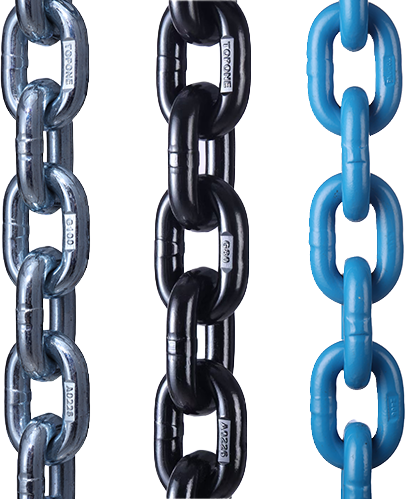
Grade 80 Lifting Chain – The Industry Standard
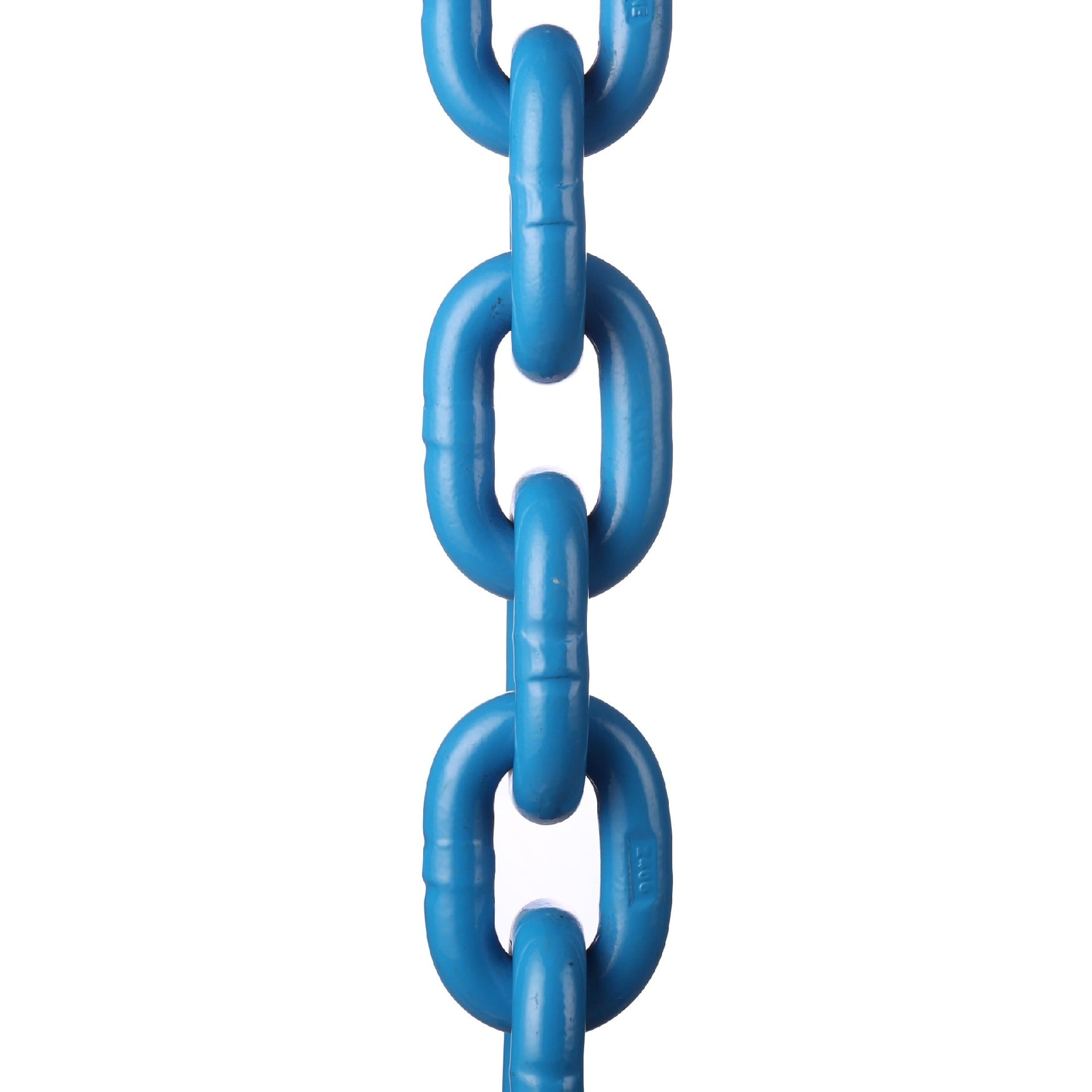
Grade 80 is the minimum standard for overhead lifting and the most widely used grade across general industrial applications. Made from high-strength heat-treated alloy steel, G80 lifting chains offer an excellent balance of strength, durability, and affordability. They are ideal for most heavy-duty lifting tasks in construction, mining, and manufacturing.
Key characteristics:
Tensile strength: 800 N/mm²
Industry standard for overhead lifting
Excellent balance of performance and cost
Suitable for most general lifting applications
Common applications:
Grade 100 Lifting Chain – Higher Capacity Without Upsizing
Grade 100 offers approximately 25% higher working load limit (WLL) than Grade 80 at the same chain diameter. This means you can lift heavier loads without increasing chain size—or lift the same load with a lighter, more manageable chain. G100 lifting chains are increasingly becoming the preferred choice for high-intensity lifting operations.
Key characteristics:
Common applications:
Heavy mining operations
Large-scale construction projects
Offshore and marine lifting
Heavy equipment manufacturing
Comparison Table: G80 vs G100
| Factor | Grade 80 | Grade 100 |
| Tensile Strength | 800 N/mm² | 1000 N/mm² |
| WLL vs G80 (same diameter) | Baseline | ~25% higher |
| Best For | General lifting, standard industrial tasks | High-capacity lifting, weight-sensitive operations |
| Cost | Lower | Higher |
| Fatigue Resistance | Good | Superior |
Important: Grade 80 and Grade 100 are both approved for overhead lifting. Chains like G30, G43, and G70 are designed for towing and load securement—never use them for overhead lifting.
Select the Right Chain Configuration
The configuration of your chain sling is just as important as the chain grade. Improper configuration can lead to uneven loading and sling failure.
Number of Legs
Single-leg slings: Suitable for vertical, straight lifts where the load is balanced.
Two-leg slings: Provide better stability for longer or irregular loads.
Three or four-leg slings: Offer superior load distribution for unbalanced or complex-shaped loads.
Master Links, Hooks, and Connectors
Every component in your lifting system—master links, hooks, connecting links, and shortening clutches—must be appropriately rated for the chain grade and application. Mixing components of different grades creates a weak point in the system. Always match all components to the same grade.
Length and Angle Considerations
When calculating chain length, consider not just the height of the lift but also the angle of the legs. As the lifting angle decreases, the load on each leg increases significantly. This must be accounted for in your load calculations.
Angle factor reference:
| Lifting Angle (from horizontal) | Angle Factor (multiply load per leg) |
| 90° (vertical) | 1 |
| 60° | 1.15 |
| 45° | 1.41 |
| 30° | 2 |
Always use manufacturer-provided angle factor tables to determine the actual load on each leg.
Consider Environmental and Operating Conditions
Chains are exposed to a wide range of environmental and mechanical stresses. Choosing the right type and protective measures can dramatically affect durability.
Temperature
Extreme temperatures affect chain strength. According to industry standards including ASME B30.9 and OSHA 1910.184, lifting components should not be used above 400°F (204°C) or below –40°F (–40°C) without reducing their WLL. For high-temperature applications, consult with your supplier about derating requirements.
General temperature derating guidelines:
Temperature Range | Effect on WLL |
Below –40°F (–40°C) | Consult manufacturer |
–40°F to 400°F | No reduction |
Above 400°F | WLL must be reduced |
Corrosive Environments
Coastal, chemical, or marine environments may require corrosion-resistant coatings or stainless steel alternatives. Galvanized or specially coated chains can significantly extend service life in corrosive conditions.
Abrasive Conditions
Chains used around aggregates, sharp edges, or rough surfaces may require additional surface hardening or protective sleeves. Alloy steel chains inherently resist abrasion better than other sling materials, but extreme conditions may demand extra protection.
Load Sensitivity
While alloy steel chains excel in harsh environments, they can damage delicate or high-value machinery. If load protection is a priority, consider whether protective padding on the chain might be appropriate.
nsure Regulatory Compliance and Traceability
Every lifting chain must adhere to relevant safety and regulatory standards. Compliance isn‘t optional—it’s the law.
Key Standards to Know
Standard | Scope |
OSHA 1910.184 | Primary US regulation for overhead lifting chains |
ASME B30.9 | Consensus safety standard for slings |
EN 818 | European standard for short-link chain slings |
NACM Specifications | National Association of Chain Manufacturers‘ welded steel chain specifications |
What to Look For
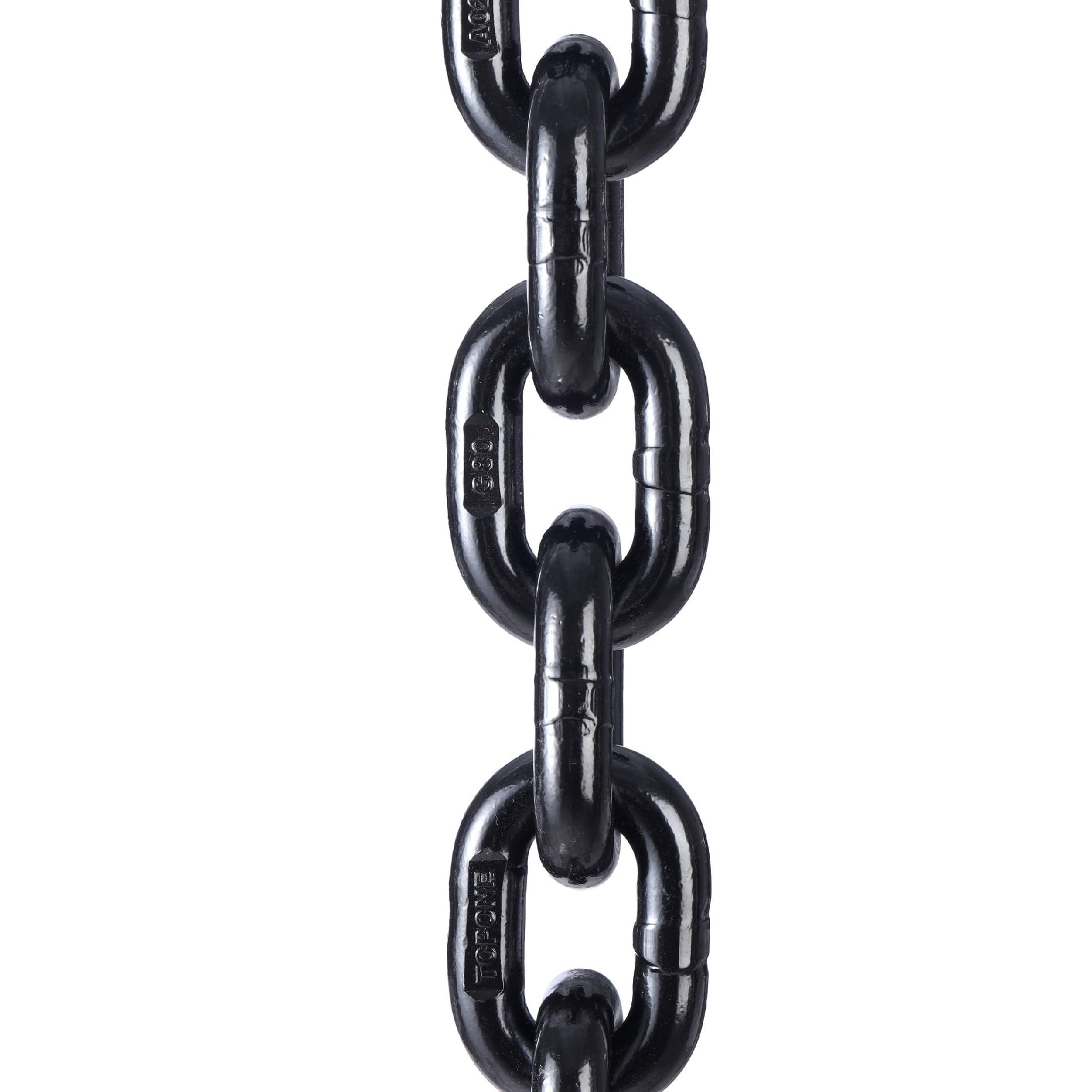
Markings: Chains should be clearly marked with grade, WLL, manufacturer ID, and batch traceability
Documentation: Keep inspection and test records as required by regulations
Certification: Only chains that meet OSHA 1910.184 and ASME B30.9 can be legally and safely used for overhead lifting
Understand Working Load Limit (WLL) vs. Breaking Load
This distinction is critical for safe lifting chain selection.
Breaking Load (Minimum Breaking Force – MBF)
This is the maximum force the chain can withstand before it physically fails. This is a test value and should never be approached in operational use.
Working Load Limit (WLL)
This is the maximum safe load the chain is designed to carry during normal operations. WLL is typically a fraction of the breaking load, incorporating a safety factor.
The 4:1 Safety Factor
For overhead lifting chains, the industry-standard safety factor is 4:1—meaning the breaking load is four times the WLL. This built-in margin accounts for dynamic forces, wear, and unforeseen stresses.
Important: Two chains of the same grade can have different WLLs depending on their diameter and link geometry. Always check the specific WLL for the chain you‘re selecting rather than assuming grade alone is enough.
The Decision Framework – G80 or G100?
If you’re trying to decide between Grade 80 and Grade 100, here‘s a simple decision framework:
Choose Grade 80 Lifting Chain When:
Your loads are within standard weight ranges
You want the most cost-effective solution
Your lifting frequency is moderate
You don’t have strict weight restrictions on your rigging equipment
Choose Grade 100 Lifting Chain When:
You need to lift heavier loads without upsizing chain diameter
Your operation involves frequent, high-cycle lifting
You want to reduce the overall weight of your sling assemblies
You‘re willing to invest in a higher-grade chain for longer service life
Your application demands superior fatigue resistance
Work with a Reputable Supplier
Partnering with a reliable supplier guarantees product quality, technical support, and consistent compliance.
Why Choose TOPONE CHAIN for Your Lifting Chain Needs
TOPONE CHAIN manufactures high-strength alloy steel lifting chains in both Grade 80 and Grade 100, quenched and tempered to meet strict safety requirements for overhead lifting. All TOPONE lifting chains are produced and tested according to international safety standards including EN 818, NACM, and ASME B30.9.
Key advantages of choosing TOPONE:
Advantage | Benefit |
Complete range | G80 and G100 alloy lifting chains available |
Superior tensile strength | Engineered specifically for cranes, rigging systems, and heavy-duty material handling |
Quality-certified manufacturing | Every chain undergoes rigorous testing and inspection |
Technical expertise | Support for calculating chain configurations and selecting the right grade |
Customization | Custom lengths, configurations, and assemblies available |
Traceability | Clear markings and documentation on every product |
Final Checklist: Choosing the Right Lifting Chain
Before making your final decision, run through this checklist:
Factor | Question | Your Answer |
Load Weight | What is the maximum weight of your heaviest load? | ___________ |
Lift Frequency | How often will the chain be used (daily lifts)? | ___________ |
Chain Grade | G80 for standard needs, or G100 for higher capacity? | ___________ |
Configuration | Single-leg, two-leg, or multi-leg sling? | ___________ |
Temperature | Will the chain be exposed to extreme heat or cold? | Yes / No |
Corrosion Risk | Is the environment coastal, chemical, or marine? | Yes / No |
Abrasion | Will the chain contact sharp edges or abrasive materials? | Yes / No |
Compliance | Does the chain meet OSHA, ASME, and EN standards? | Yes / No |
Traceability | Is the chain clearly marked and documented? | Yes / No |
Supplier | Are you working with a reputable, certified manufacturer? | Yes / No |
Conclusion
Selecting the right lifting chain involves thoroughly assessing load requirements, chain grades, configuration, environmental factors, and regulatory standards. The wrong choice can lead to equipment failure, regulatory non-compliance, or serious accidents. The right choice delivers safety, efficiency, and long service life.
TOPONE CHAIN offers a full range of high-strength alloy lifting chains—Grade 80 and Grade 100—manufactured to international standards and designed for the most demanding lifting applications.
Need help selecting the right lifting chain for your operation? Contact TOPONE CHAIN for expert technical support and customized solutions tailored to your specific application.
TOPONE CHAIN
TOPONE CHAIN specializes in the manufacture of high-strength alloy steel lifting chains for overhead lifting, rigging, and heavy-duty material handling. All products are manufactured and tested according to EN 818, NACM, and ASME B30.9 standards, ensuring safety, reliability, and regulatory compliance. With a commitment to quality and customer satisfaction, TOPONE delivers lifting chain solutions that meet the demands of the most challenging industrial environments.