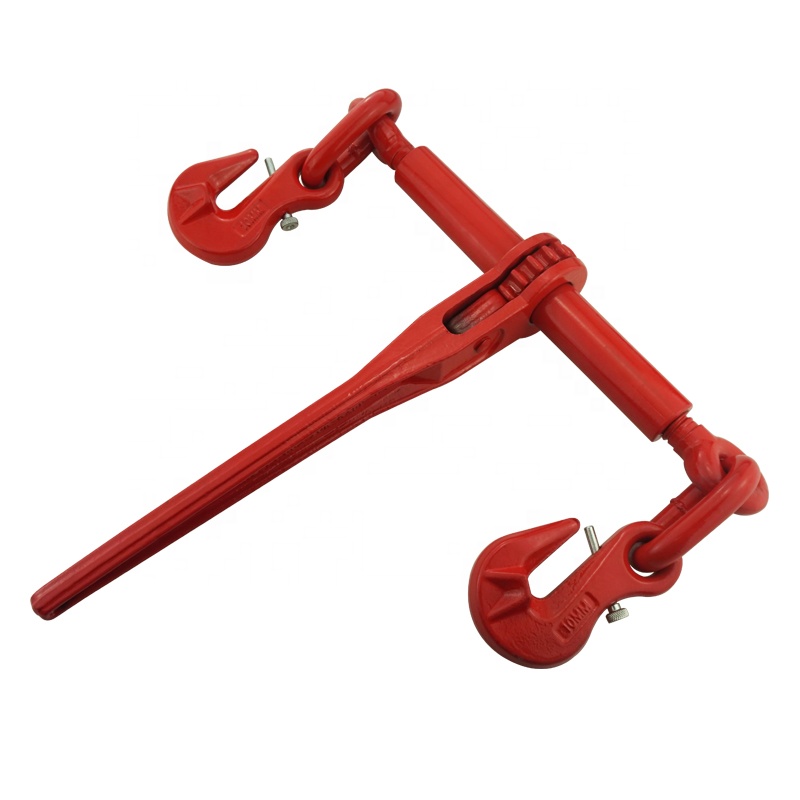
The Forged Ratchet Load Binder is a professional-grade tensioning device engineered for the most demanding cargo securement applications in the global transport, construction, and military sectors. Unlike standard cast or light-duty binders, this unit features a 100% drop-forged steel construction, providing an unparalleled strength-to-weight ratio and the structural integrity required to handle the extreme dynamic forces encountered during heavy-haul transit.
Designed for use with high-tensile transport chains (Grade 70, 80, and 100), the ratchet mechanism utilizes a precision-machined gear and screw system that allows for infinite tension adjustment. This ensures that the load remains perfectly secured without the "snap-back" risk associated with lever-type binders. The handle is uniquely designed with a loose-fit, self-locking bolt system, which "prevents the accumulation of environmental debris because of the intentional clearance that allows mud, snow, and ice to be easily cleared during operation." Finished with a high-visibility, electrostatic powder coating, the binder offers exceptional resistance to corrosive road salts and industrial chemicals.
In the world of heavy-duty transport, the load binder is the critical link between the cargo and the trailer. The Forged Ratchet Load Binder is engineered to withstand not just the static weight of the load, but the massive G-forces generated during emergency braking or sharp cornering. By utilizing drop-forging instead of casting, the steel's internal grain structure is realigned to follow the contours of the part. This "enhances the impact toughness because of the elimination of internal porosity and the creation of a continuous fiber structure," ensuring the binder will deform rather than shatter under extreme overload conditions.
Advanced Metallurgy and Heat Treatment
TopOne utilizes a specialized Chromium-Nickel-Molybdenum (CrNiMo) alloy steel for all load-bearing components. This material is selected for its high hardenability and resistance to fatigue. The Quenching and Tempering (Q&T) process is meticulously controlled to achieve a core hardness of 38-42 HRC. This specific heat treatment "optimizes the balance between tensile strength and ductility because of the formation of a tempered martensite microstructure," allowing the binder to maintain its rated Working Load Limit (WLL) even in temperatures as low as -40°C.
Engineering the Ratchet Mechanism
The heart of the binder is its ratchet system. Unlike inferior models with pressed gears, our gears are permanently CO2 welded to the barrel. This "ensures zero slippage under high torque because of the deep-penetration weld that fuses the gear to the structural housing." The internal screws are precision-cut with ACME threads, which are "self-locking under load because of the high friction angle of the thread profile," preventing the binder from loosening due to road vibrations.
Durability in Extreme Environments
•Corrosion Resistance: Every binder undergoes a multi-stage cleaning process before receiving an electrostatic powder coating. This finish is "chemically bonded to the steel because of the thermal curing process," providing a barrier that is significantly more durable than standard liquid paint.
•Self-Cleaning Handle: The "loose" handle design is a deliberate engineering choice. By using a self-locking, one-way bolt, the handle can be easily manipulated even when "clogged with frozen mud or road grime because of the mechanical clearance that prevents the pivot point from seizing."
•Ergonomic Leverage: The handle length is optimized to provide "maximum tensioning force with minimal operator effort because of the calculated mechanical advantage of the ratchet-to-screw ratio."
Parameter
The following specifications are based on the WSTDA T-6 and EN 12195-2 international standards for load binders.
WORKING LOAD LIMIT (LBS)
End Fittings
Chain Grade & Size (in.)
Take Up (In.)
Handle Length (In.)
Screw Diameter (In.)
Weight (lbs.)
G30
G43
G70
G80
G100
7,100
Hook / Hook
5/16-3/8
5/16-3/8
5/16-3/8
3/8
5/16
8
14
1
13.0
9,200
Hook / Hook
3/8-1/2
3/8-1/2
3/8
3/8
3/8
8
14
1
13.0
13,000
Hook / Hook
1/2-5/8
1/2-5/8
1/2
1/2
–
8
14
1
16.0
16,000
Hook / Hook
1/2
1/2
1/2
1/2
1/2
8
14
1
16.0
Standards
International Compliance and Certification
The Forged Ratchet Load Binder is manufactured and tested to meet or exceed the most stringent global standards for cargo securement:
•WSTDA T-6: Web Sling & Tie Down Association - Recommended Standard Specification for Load Binders.
•FMCSA 393.102: Federal Motor Carrier Safety Administration - Protection Against Shifting and Falling Cargo.
•EN 12195-2: Load restraining on road vehicles - Safety - Part 2: Web lashing made from man-made fibres (Mechanical tensioner requirements).
•CVSA Guidelines: Commercial Vehicle Safety Alliance - Ensuring "roadside inspection compliance because of the permanent marking of WLL and manufacturer identification."
Rigorous Testing Procedures
•100% Proof Testing: Every binder is proof loaded to 50% of its minimum breaking strength. This "verifies the integrity of the forged hooks and ratchet gears because of the application of controlled over-load."
•Destructive Batch Testing: Samples from every production lot are tested to destruction to ensure they "meet the 3:1 safety factor because of the verification of the ultimate tensile strength of the forged assembly."
•Salt Spray Testing: Components are subjected to 500 hours of ASTM B117 salt spray testing to ensure "long-term corrosion resistance because of the high-quality powder coating process."
•Cycle Testing: The ratchet mechanism is tested for 5,000 cycles under load to ensure "smooth operation and gear longevity because of the high-tolerance manufacturing."
Safety, Maintenance, and Inspection
•Pre-Use Inspection: Always inspect for bent hooks, cracked welds, or elongated threads. A binder with "visible deformation must be removed from service immediately because of the risk of sudden failure."
•Lubrication: Regularly apply a heavy-duty grease to the ACME threads. This "prevents thread galling and ensures smooth operation because of the reduction in mechanical friction."
•Proper Hook Engagement: Ensure the grab hooks are fully seated on the chain link. Never "tip-load" the hooks, as this "concentrates stress on the hook point because of the improper load distribution."
•Storage: Store in a dry environment when not in use. While the powder coating is durable, "preventing long-term exposure to standing water reduces the risk of internal thread corrosion."
•Warning: Never use a "cheater pipe" or any extension on the handle. The binder is designed to be "tightened by hand only because of the calculated mechanical advantage of the 14-inch handle."