Clinker is coarse and abrasive; limestone adds lump impact; raw meal and cement powder are fine and dusty. Elevator selection must use the actual material, not lift height alone.
Common Applications
Clinker vertical transport
Cement production lines
Raw meal conveying
Powder material lifting
Bulk storage transfer
System Definition
Material and Discharge Method
Record bulk density, particle size, largest lump, moisture, abrasiveness, flowability and operating temperature. Gravity discharge supports controlled lower-speed operation; centrifugal discharge depends on speed and material trajectory. Bucket shape, spacing, speed and head geometry must work together. ISO 7190:1981 classifies bucket elevators.
Elevator Architecture
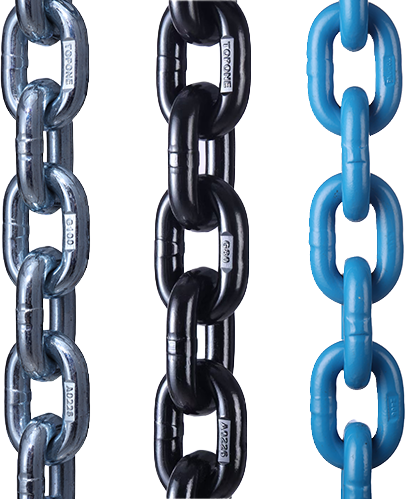
Calibrated round-link elevators can use DIN 764 or DIN 766 chain geometry with shackles and bucket attachments, or long-pitch chain with toothed wheels. ISO 5050:1981 covers vertical bucket elevators with calibrated round steel link chains. ISO 5051:1981 specifies main dimensions of deep buckets with flat rear walls.
Other machines use forged, pin-and-bush or plate chain, or belts. These systems are not interchangeable. Chain, wheel and bucket interfaces must follow the OEM drawing.
Capacity and Chain Force
Theoretical mass flow is:
Q = 3600 Vb ρ φ v / p
Vb is bucket volume in m³
ρ is bulk density in t/m³
φ is the filling factor
v is chain speed in m/s
p is bucket spacing in m
Head-chain force includes chain, buckets and material plus boot loading, friction, acceleration and plugging. Select by maximum working pull, drive torque, duty factor and minimum breaking force; lifting-chain WLL does not apply. Take-up tension must maintain engagement without overloading the chain.
Twin strands share load only when lengths, attachments, wheels and take-up are aligned. A published long-pitch reference limits difference within a matched pair to 0.05%, with 1 mm minimum tolerance for short chain ends. This is a specification example, not a universal TOPONE tolerance.
Chain Engineering
Material and Heat Treatment
Abrasive clinker requires a hard contact surface and tough core. A published case-hardened round-link specification uses surface hardness above 64 HRC, minimum effective case depth of 0.07d and total carburized depth of 0.11d, where d is link diameter. TOPONE must confirm hardness, depth, core properties and test forces for each order.
Temperature can reduce hardened properties, while impact or high tension may require another alloy and heat-treatment balance. Use measured chain temperature, not kiln gas temperature elsewhere in the process.
Manufacture and Interfaces
Round-link production requires controlled forming, butt welding, heat treatment and calibration. Inspection should verify material, diameter, pitch, width, matched length, proof force and minimum breaking force.
Welded steel deep buckets suit powder and mixed-size material; clinker may need thicker or wear-protected buckets. Bucket mass, volume, holes, lip and casing clearance must match the system. Case-hardened pins and induction-hardened attachment holes can reduce articulation wear.
Toothed or pocket wheels require exact pitch, root profile and clearance. Replaceable teeth simplify repair, but material, hardness and mounting remain critical. New chain on hooked or pitch-worn wheels causes impact and rapid elongation.
Monitoring and Maintenance
Operating Protection
Monitor speed, motor torque, bearing temperature, chain deviation, take-up and boot level. An underspeed trip should stop upstream feed before overfilling. Monitor temperature where clinker can heat components beyond approved limits.
Inspection and Replacement
Record baseline pitch and link section. Guidance uses a preliminary check after about 100–150 operating hours and later checks commonly every one to three months; OEM intervals take priority.
For toothed wheels, 3% pitch extension is a general replacement reference, not a universal limit. Section loss, fatigue or wheel wear may require earlier removal.
Guard the head, boot, drive, take-up and openings. Before clearing blockage or entering the casing, isolate the drive, backstop and stored energy under ISO 1819, ISO 7149 and local rules.
Information Required by TOPONE
Material and conveying stage
Density, lump size, abrasiveness and moisture
Material and chain temperatures
Capacity, lift height and chain speed
Chain system, size, pitch, grade and strand count
Bucket mass, volume, spacing and attachment
Head and boot wheel profiles and tooth counts
Drive torque, start method and backstop
Take-up travel and wear measurements
Testing, certificates and traceability