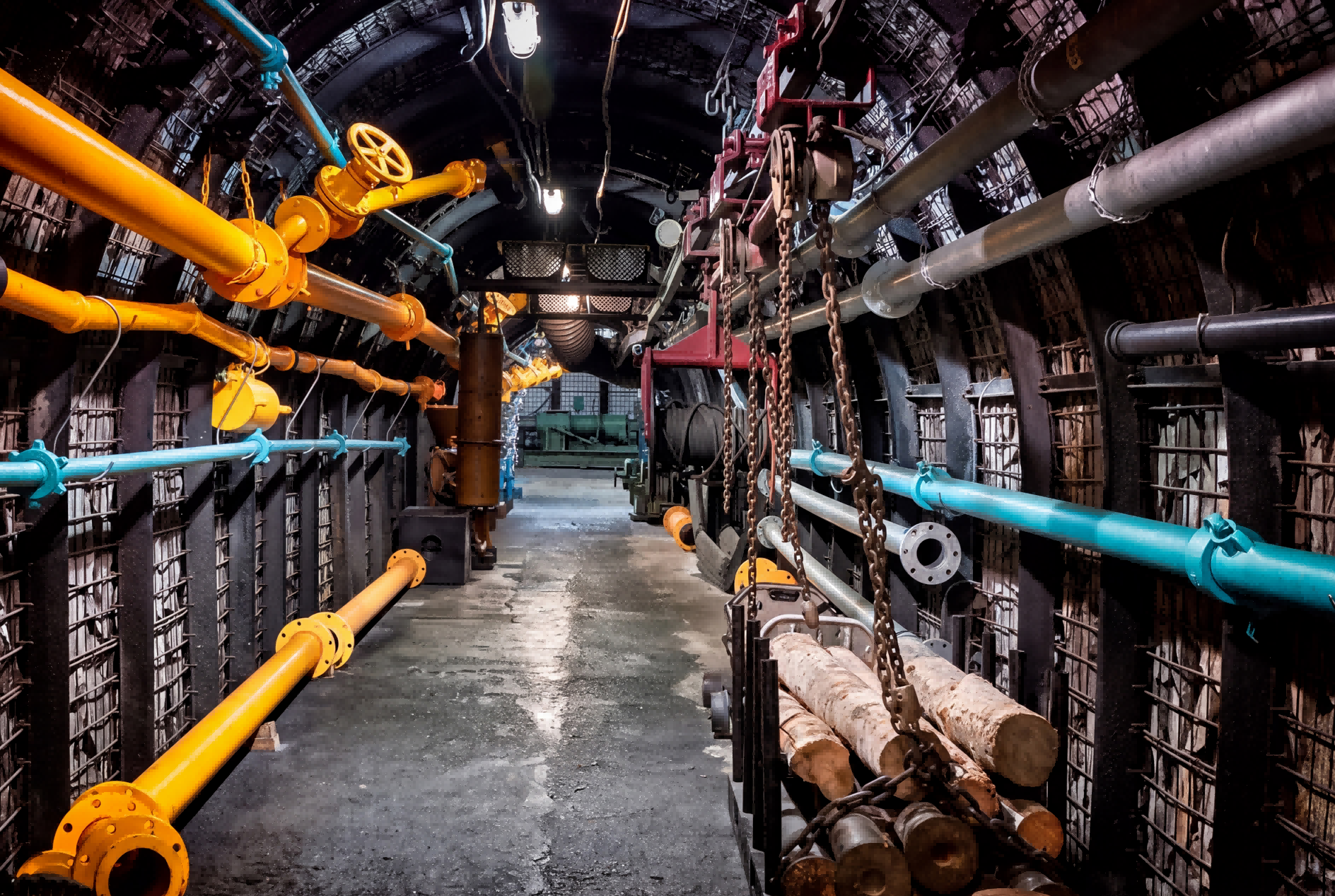
Underground mines use suspended monorails and endless-rope haulage to move tools, supports, pipes, spares, and heavy equipment through narrow or inclined roadways. Suspension chain transfers rail loads into the roof; wire rope transmits traction around a closed route. Their ratings are not interchangeable.
Typical Applications
Underground material transport
Tunnel equipment movement
Mining maintenance logistics
Approved personnel transport systems
Heavy component transportation
Separate the Two Load Paths
Suspended Monorail
Load passes from carrier wheels into the rail, suspension claws, shackles, chains, roof anchors, and strata. Rail joints, curves, gradients, braking, and a wheel below a hanger can produce higher local reactions than payload divided by the support count.
Hanger spacing and vehicle load must come from the approved layout, rail data, roof-control plan, anchor capacity, and dynamic calculation. Extra hangers do not ensure equal sharing where chain lengths differ.
Endless Rope Winch
An endless-rope system uses a continuous rope loop with a winch, drive and return stations, tensioner, curve rollers, guides, vehicle attachments, brakes, signalling, and controls.
Required rope pull includes vehicle rolling resistance, gradient force M × g × sin θ, acceleration, rope self-weight, sheave losses, and starting or braking effects. Peak demand may occur during a loaded start or abnormal resistance rather than steady travel.
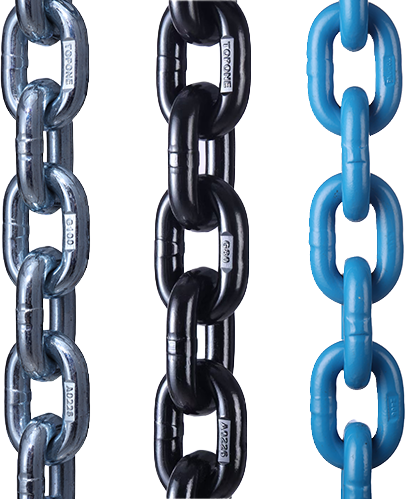
TOPONE Monorail Suspension Chain
Verified DIN 20637 Data
DIN 20637:1997-10 covers tested, long-link round steel chains for mining monorail suspensions. TOPONE’s 16 × 80 mm chain has diameter 16 ±0.6 mm, pitch 80 ±1.5 mm, test force 60 kN, breaking force 180 kN, maximum elongation 1.6% at test force, minimum elongation 2.0% at breaking force, and mass 4.7 kg/m.
Test and breaking forces are verification values, not a permissible hanger load. Rate the complete suspension with compatible components. DIN 20635 covers suspension shackles; DIN 20636 covers suspension claws and testing.
Do Not Substitute Chain Types
DIN 22252 is conveyor traction chain, while Grade 80 chain is for rated lifting assemblies. Neither automatically replaces DIN 20637 suspension chain. Welding, heating, twisting, or placing an ordinary bolt through a link introduces stresses absent from axial test data.
Select the Haulage Rope as a System Component
Rope Construction
Diameter alone does not define suitability. Specify construction, core, lay, wire grade and finish, minimum breaking force, lubrication, and connection after checking traction method, sheave diameter, bend frequency, groove, route, gradient, speed, and contamination.
A low wire-count rope is relatively stiff; a higher wire-count construction bends more readily but has different wear behavior. The rope must fall within the winch manufacturer’s approved range. ISO 2408 is not a governing mining-rope standard because its scope excludes mining ropes.
Tension, Grip, and Braking
Low pretension can cause slip or slack rope; excessive pretension loads the rope, bearings, return station, and anchors before travel starts. Verify traction under wet or contaminated conditions, tensioner travel, splice or coupling, vehicle grip, service and emergency brakes, overspeed or slack-rope protection, and stop signalling.
Material-haulage approval does not authorize passenger transport. Personnel movement requires separately approved vehicles, braking logic, communication, inspection, and operating rules.
Inspection and Maintenance
Inspect rail alignment, joints, hangers, anchors, claws, shackles, link wear, elongation, twist, corrosion, and roof movement. Record rope diameter and examine broken wires, corrosion, abrasion, crushing, kinks, waviness, lubrication, splices, grips, and sheave-running zones.
Inspect grooves, rollers, guards, tension travel, brakes, and controls. Reinspect after derailment, shock load, rope slip, emergency braking, flooding, roof movement, or jamming. Apply mine-authority, manufacturer, and approved-plan discard limits; do not invent a universal broken-wire or wear percentage.
Information Required by TOPONE
Payload and vehicle mass
Material-only or approved personnel duty
Route length, gradient, curves, speed, and starts per shift
Rail profile, hanger spacing, anchor, claw, and shackle details
Winch, sheave, groove, rope, and tensioning data
Required standards, certificates, and inspection requirements