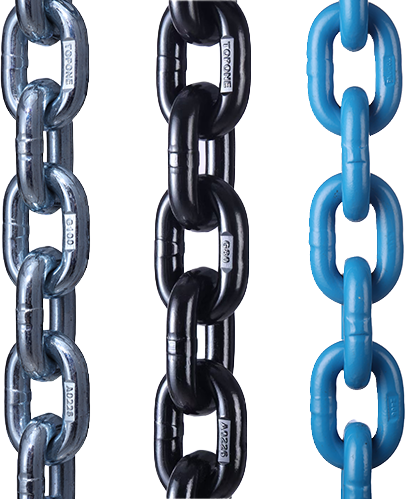
Bucket elevators move ore, coal, cement material and bulk minerals between crushing, screening and storage stages. The chain carries its own mass, buckets and material while bending around the head and boot wheels. Selection must address tension, articulation, wear and matched length as one system.
Typical Applications
Ore lifting systems
Coal preparation plants
Cement material handling
Mineral processing facilities
Bulk powder transportation
Select Chain from the Elevator Design
Chain and Wheel Arrangement
A pocket-wheel system requires calibrated chain whose pitch and widths match every pocket. A toothed-wheel system may use long-pitch chain, dedicated teeth, connectors and bucket pins. Bucket brackets or shackles must match chain and bucket geometry; a general lifting shackle is not an automatic substitute.
DIN 5698-1 covers case-hardened Grade 2 bucket-elevator chain with pitch 2.8d. DIN 5696-1 covers Grade 2 chain at 3.5d, and DIN 762-1 covers Grade 2 chain strands at 5d. DIN 766 covers Grade 3 quenched-and-tempered chain at 2.8d for conveyors and bucket elevators. These conveyor chains must not be used as lifting slings or hoist load chain.
Material and Temperature
Ore produces interlink, sprocket and attachment wear, while impact and misalignment require core toughness. Case hardening provides a hard surface with a tougher core; quenched-and-tempered chain provides another strength-toughness balance. The selected standard and elevator OEM must define the treatment.
DIN 5696-1 and DIN 766 cover their specified chains from -20°C to +400°C. This is not a complete-elevator rating. Buckets, connectors, lubrication or material may set a lower limit, so measure chain temperature for hot feed.
Calculate Payload and Chain Mass
Throughput and Pull
Preliminary flow is Q = 3.6 × V × φ × ρ × v ÷ s, where Q is t/h, V is bucket volume in m³, φ is fill factor, ρ is bulk density in kg/m³, v is chain speed in m/s and s is bucket spacing in metres. This checks throughput, not chain capacity.
Required pull also includes chain and bucket mass, vertical material mass, boot filling resistance, acceleration, friction, misalignment, buildup and restart after a loaded stop. Equal division between two chains requires matched lengths, tension and bucket alignment.
TOPONE 20 x 56 Example
TOPONE lists DIN 766 chain with 20 mm diameter, 56 mm pitch, 24 mm inside width, 68 mm outside width and 9.0 kg/m mass. Eleven links measure 616 mm with a listed +7.4/-3.7 mm tolerance.
A 40 m strand therefore weighs about 360 kg; two strands total about 720 kg, equivalent to 7.1 kN of gravitational force before buckets and material are added. This shows why payload alone cannot determine chain size. It is a dead-mass calculation, not allowable head-shaft tension.
Control Matching, Installation and Wear
Matched Components
Dual-strand elevators need paired lengths so buckets remain level and load is shared. Record strand identity, length over fixed pitches, bucket spacing and tension before commissioning. Do not mix standards, grades, treatments or unmatched lengths without approval.
Wheel geometry must match pitch and link widths. Worn pockets create impact at engagement. Check connector and bucket-link strength with the chain because the weakest part governs. Never field-weld, heat or reshape a chain link.
Inspection during Service
Inspect interlink diameter loss, pitch extension, flats, pitting, twist, weld-zone cracks, bucket bolts, attachment holes, connector locks and wheel wear. Compare both strands for length and tension. Boot buildup, misfeeding, unusual noise, current spikes or a loaded restart require extra inspection. Apply the standard and OEM discard limits; one wear percentage cannot cover every system.
Information Required by TOPONE
Provide material density, particle size, moisture, abrasiveness and temperature; required t/h; lift height; bucket volume, spacing and mass; chain speed; strand number; head and boot wheel drawings; existing chain size and standard; motor power; starts per hour; tensioning method; corrosion history and required certification. TOPONE can match chain geometry, treatment, bucket attachments and wheel interfaces for elevator-manufacturer approval.