Marine cargo lashing restrains sliding and tipping caused by ship accelerations. Containers, vehicles, machinery, steel and pipe cargo require different arrangements; one chain specification cannot secure every load.
Securing Design Basis
Cargo Securing Manual and Forces
Under SOLAS, non-bulk cargo and cargo transport units must remain secured throughout the voyage in accordance with the ship’s approved Cargo Securing Manual. RoRo securing must be completed before departure. Calculations consider mass, centre of gravity, stowage position, accelerations, friction, tipping geometry and lashing direction.
Direct lashings restrain movement through their force components. Top-over lashings increase friction through pretension. Cradles or chocks should restrain rolling cargo first. Friction values require defined contact materials.
MSL and Calculated Strength
Maximum Securing Load, not lifting WLL, governs marine lashing. CSS Code Annex 13 assigns default MSL values of 50% of breaking strength for chain and web lashing, 30% for reusable wire rope and 80% for single-use wire rope. In its standard balance method, Calculated Strength is MSL divided by 1.5; alternative methods use their stated factors. A prescribed device value takes priority.
Chain, hook, shackle, binder, deck eye and foundation form one load path. The lowest approved MSL limits the assembly.
Solutions by Cargo Type
Containers
Container ships use cell guides, twistlocks, lashing rods and turnbuckles. General cargo ships may use approved chains or wire ropes with tensioners. ISO 3874:2017 covers Series 1 container handling and securing. Lashings must use approved points.
RoRo Vehicles and Trailers
Vehicles require parking brakes, gear engagement and chassis-connected securing points. Uncoupled semi-trailers should use trestles instead of relying on landing legs. IMO MSC.479(102) states that RoRo road-vehicle lashings should generally have MSL of at least 100 kN unless their number and MSL are calculated under CSS Code Annex 13. Hooks must remain engaged if slack develops, and only one lashing may use each aperture.
Machinery, Steel and Project Cargo
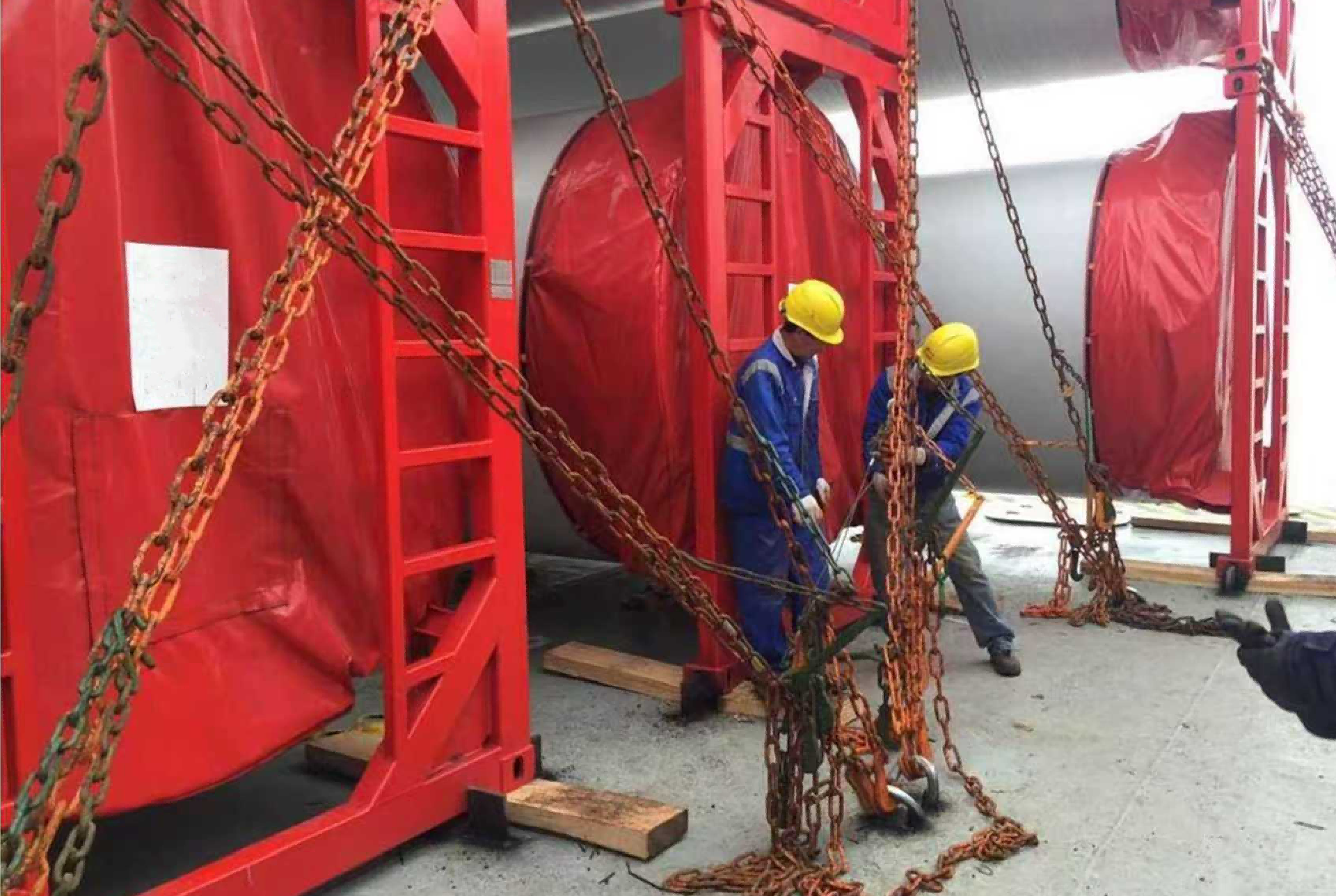
Machinery and steel structures use opposed direct chain lashings connected to engineered transport points. Pipes require cradles, wedges or chocks. Webbing protects sensitive surfaces; chain suits abrasion-prone load paths with edge protection.
TOPONE Lashing Components
Chain, Hooks and Tensioners
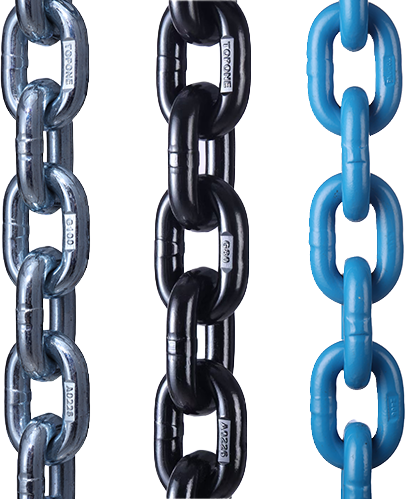
The TOPONE catalogue includes G70 binder chains with clevis grab hooks, G80 binder-chain assemblies and lever-type load binders. Catalogue ratings do not automatically constitute approved shipboard MSL. Each assembly must match the Cargo Securing Manual, calculated load, required MSL, length, fittings, tensioning method and corrosion conditions.
An open grab hook cannot be assumed to meet the RoRo non-disengagement requirement. Lever binders require positive retention against release. Lifting slings, anchor chains and lashing chains are not interchangeable solely because diameter or grade is similar.
Material and Production Control
Specifications should define chain grade, steel, link dimensions, welding, applicable heat treatment, proof and breaking tests, coating, marking and traceability. Marine exposure requires corrosion protection or allowance.
Installation and Inspection
Correct Assembly
Use balanced restraints in opposing directions and keep chains untwisted. Do not side-load hooks, connect incompatible fittings or cross unprotected edges. Pretension must not deform cargo or overload securing points. Credit anti-slip material only when its rated performance and contact conditions match the calculation.
Inspection
Before loading, verify identification, MSL, certificates and condition. Reject cracked, stretched, twisted, deeply corroded or worn chain, distorted hooks, defective binders and damaged deck eyes. Recheck lashings when required and safe access is available.
Information Required
Provide cargo mass, dimensions, centre of gravity and footprint; cargo and deck securing-point MSL; vessel, route and stowage position; accelerations; friction and blocking; chain length, fittings, tensioner, corrosion protection and certificates.
Applicable references include SOLAS Chapters VI and VII, the 2021 CSS Code with Annex 13, the 2014 CTU Code, IMO MSC.479(102) and ISO 3874:2017. Final approval is vessel- and voyage-specific.