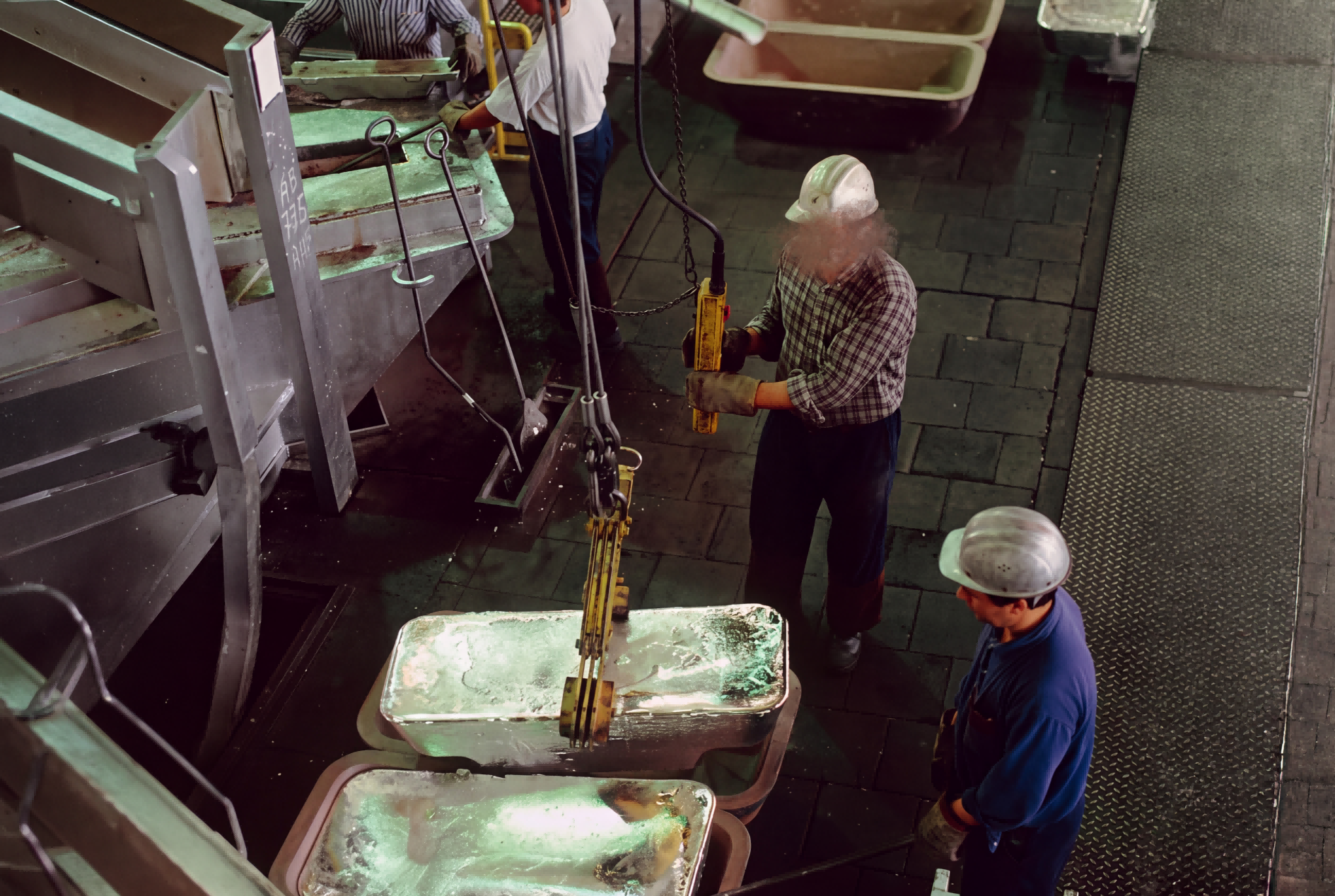
Foundries lift ladles, molds, furnace doors, rollers and refractory assemblies. Heat, scale, dust and repeated cycles affect rigging capacity and inspection. Use the temperature reached by each sling component; radiation and splash can raise it rapidly.
Typical Applications
Ladle lifting operations
Foundry material handling
Furnace maintenance
Steel plant servicing
High-temperature workshop transport
Separate Hot-metal Transport from Maintenance Lifting
Molten-metal Ladles
A filled ladle is not an ordinary chain-sling load. It requires a purpose-designed hot-metal crane, ladle trunnions or bail, matched ladle hooks, or an engineered beam. Do not wrap chain around the shell, lip or refractory lining. OSHA 1910.179 requires each independent hoisting unit on a hot-metal crane with power-control braking to have at least two holding brakes. The crane, ladle interface, tilt restraint, route and exclusion zone must be assessed as one system.
Cooled Components
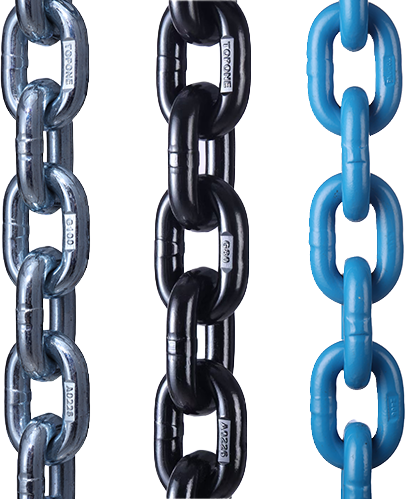
TOPONE G80 chain slings can be configured for cooled molds, furnace doors, frames and maintenance parts after verifying the tag, WLL, temperature, angle and lifting points. Seat hooks correctly; do not side-load them or run chain over sharp edges. A spreader beam can increase heat clearance, reduce sling angle and prevent load contact.
Calculate Capacity before Choosing Chain
Gross load includes retained metal, sand or cores, refractory, fixtures and adhered material. Confirm mass, center of gravity and lifting points. For a symmetric two-leg sling, ideal leg force is T = W ÷ (2 × cos β), with β measured from vertical; unequal loading and movement need separate allowance.
Catalogue-based Example
For a verified 20 t cooled mold, TOPONE's EN 818-4 G80 table rates 24 mm two-leg chain at 19.6 t for β ≤ 45° and 14.0 t for 45° < β ≤ 60°; it is insufficient. Based only on catalogue WLL, the first listed size above 20 t is 26 mm at β ≤ 45° with 23.8 t WLL, or 30 mm at 45° < β ≤ 60° with 22.0 t WLL. This screens size only; the weakest component, heat, asymmetry, hook fit, shock and site rules govern final approval.
Select Rigging by Measured Temperature
G80 Alloy Chain
The TOPONE catalogue specifies special quenched-and-tempered alloy steel, EN 818-4, a 4:1 design factor and traceability markings. These data do not approve direct molten-metal service. Record peak chain and hardware temperature and exposure time. OSHA requires manufacturer-directed WLL reduction above 600°F (316°C) and permanent removal if an alloy chain sling exceeds 1000°F (538°C). These are outer regulatory limits; the manufacturer or project may set lower limits. Unknown overheating, discoloration, heavy scale, arc damage or molten splash requires quarantine and competent examination.
Wire Rope and Textile Slings
Core and lubrication determine wire-rope heat limits. OSHA requires permanent removal of fiber-core wire-rope slings exposed above 200°F (93°C); nonfiber-core rope above 400°F (204°C) needs manufacturer guidance. ISO 4309 addresses crane-rope care, inspection and discard, including ladle duty. OSHA limits polyester and nylon web slings to 180°F (82°C), and polypropylene to 200°F (93°C). Remove webbing showing melting or charring; keep it outside radiation and splash zones.
Control Repeated Foundry Lifts
Before and during Use
For furnace maintenance, isolate electrical, hydraulic, mechanical and thermal energy; confirm the part and refractory are stable. Inspect identification, chain wear or elongation, cracks, deformation, hook throat and latch, master link and connectors. Do not mix grades, improvise shortening or field-weld load-bearing parts. Test-lift for balance; avoid shock, dragging, twisting and side pull.
Inspection Interval
OSHA requires inspection before daily use and additional checks where conditions warrant. Recorded periodic inspection of alloy chain slings must reflect frequency, severity and lift type, and may never exceed 12 months. Hot, high-cycle service can justify a shorter documented interval. Tag out any sling exposed to an unknown or exceeded temperature until its disposition is confirmed.
Information Required by TOPONE
Provide gross mass, item and rigging temperatures, exposure time, heat-source distance, dimensions, center of gravity, lifting points, sling angles, headroom, crane-hook size, lifts per shift, contaminants and governing standard. TOPONE can then configure chain, master link, shortening device, hooks or shackles and spreader interface for review within the complete lifting plan.