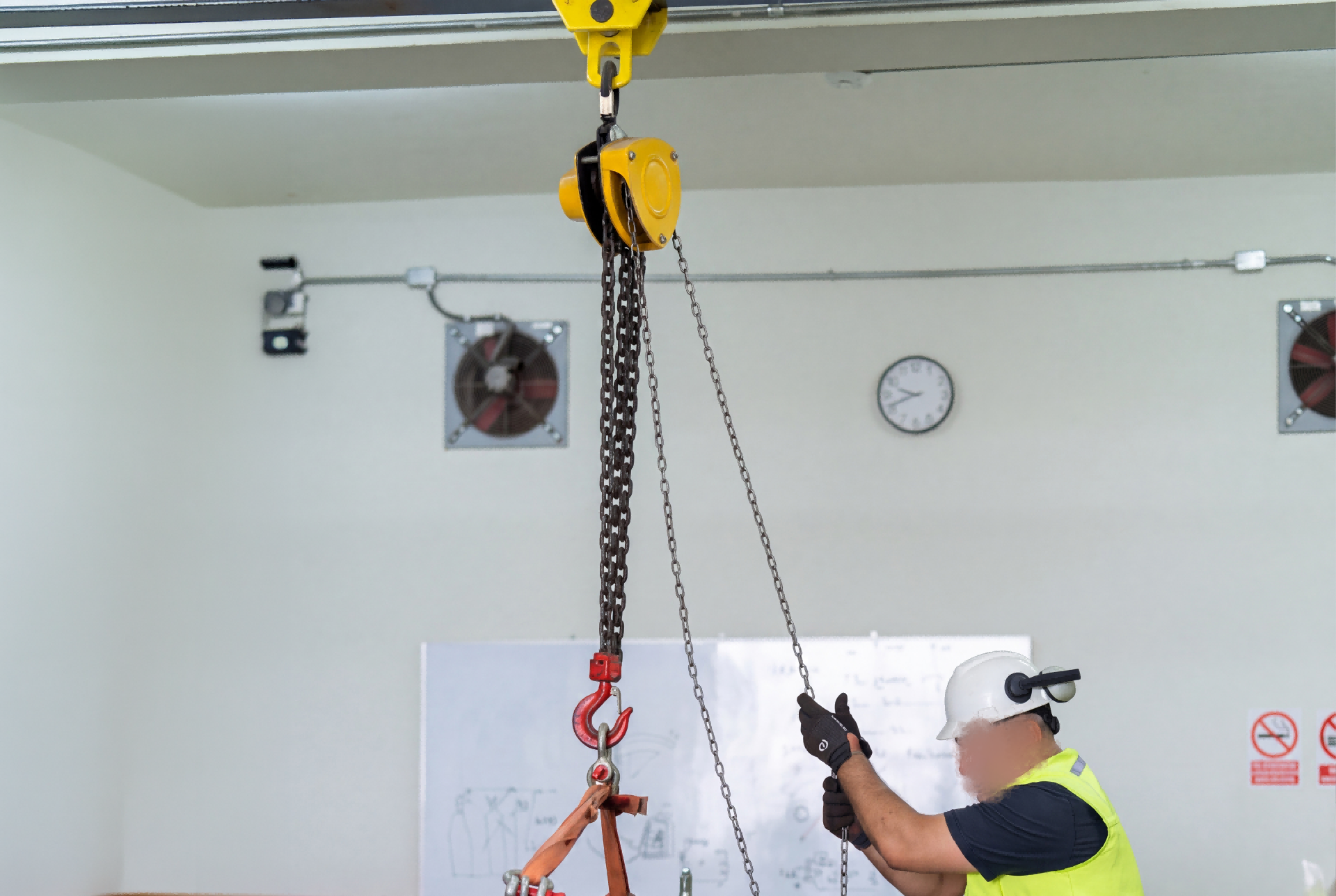
Warehouses use chain hoists where machinery, motors, dies, industrial parts or containers must be lifted and positioned at a fixed bay with limited floor space. The hoist provides vertical movement; a compatible trolley on a rated runway beam enables controlled travel.
Typical Applications
Warehouse cargo lifting
Storage-rack installation and maintenance
Internal logistics movement
Workshop material transfer
Loading and unloading at fixed bays
System Arrangement
Suspend the hoist only from an engineered and rated beam, monorail, gantry or trolley. The support, trolley, hoist, hook and lifting attachment must all suit the operation; system capacity is limited by the lowest-rated component. Rack beams and uprights are not suspension points unless specifically engineered and approved for lifting.
Keep the hoist vertically above the load. Use a compatible trolley for horizontal travel after the load is clear; never side-pull the load chain or drag a suspended load. Check the complete route for obstructions and personnel.
Manual or Electric Chain Hoist
A manual chain block suits occasional lifts, maintenance work and locations without a convenient electrical supply. It provides controlled positioning but relies on operator effort.
An electric chain hoist suits repeated handling only when its duty class, starts per hour, lifting speed, power supply and controls match the workflow. Define load spectrum, operating time, lift height, starts, travel and ambient conditions before selection. Capacity alone does not qualify a hoist for high-frequency service.
Low-Headroom Bays
Clearance below roofs and mezzanines often controls selection. TOPONE’s HHBB range is catalogued with a layout that reduces the distance between the hoist body and beam track. The HHBB-2.0B is rated at 2.0 t with 3 m standard lift, 1.5 kW motor, 3.4 m/min lifting speed, two falls of 7.1 mm load chain and 69 kg net weight. These figures apply only to this model. Voltage, duty rating, ingress protection, controls and site compliance must be confirmed for each order.
Load Interface
Pallet boards, shrink wrap, cartons and packaging straps are not lifting points. Use an approved pallet lifter, lifting frame or other device designed for the cargo. Machinery should use designated lifting lugs or an engineered frame. Suspended mass includes the cargo, lifter, slings, shackles and every attachment.
For an offset center of gravity, arrange lifting points so the hook remains over the combined center of gravity. Protect slings at sharp edges, contain loose parts and never rely on packaging that can crush or shift.
Verified TOPONE Manual-Hoist Example
For an occasional maintenance bay, the TOPONE HSZ-C2 manual chain block is catalogued at 2 t rated capacity, 3 m standard lift and 3 t test load. Its minimum distance between hooks is 380 mm; it uses two falls of 8 mm load chain and has a net weight of 14 kg. The catalogue lists a load limiter as an available option. Selection still requires verification of total mass, headroom, support and operating conditions.
Hoist Chain Requirements
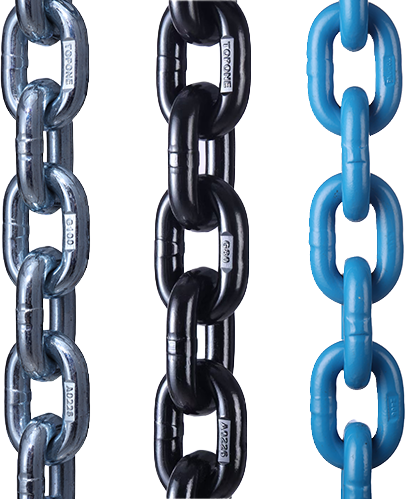
TOPONE identifies the HSZ-C load chain as high-grade alloy steel. When EN 818-7 or ISO 3077 is specified, use fine-tolerance Grade T hoist chain made, heat-treated and tested to the relevant standard. It must match the load wheel, guides and reeving system in diameter, pitch, width and material condition. General chain-sling chain of similar diameter is not a replacement for hoist chain.
Selection and Inspection
Confirm suspended mass, center of gravity, lift, headroom, support, trolley, operating frequency, route, power and environment. For powered equipment, specify the required braking, overload protection, travel limits and emergency controls under the applicable standard.
Before use, inspect identification, suspension, trolley, hooks, latches, brake, controls, limits, chain container and reeving. Check chain for wear, elongation, twist, gouges, corrosion and stiff links against the manufacturer’s limits. Remove abnormal equipment from service. Never overload, shock-load, side-pull, lift people, stand beneath a suspended load or use a limit switch as the normal stop.
Applicable Standards and TOPONE Solution
Hand-operated hoists may be specified to EN 13157, powered hoists to EN 14492-2, and relevant hoists to ASME B30.16 where required. TOPONE can match the hoist, trolley, load chain, hooks and lifting accessories to verified load, beam, headroom and duty data. Final configuration should be confirmed from an application sheet and technical documents.