Excavators, crawler cranes, drilling rigs and mining vehicles require controlled transport between jobsites, ports and plants. Their mass, concentrated loads and repeated handling require a machine-specific securing plan.
Applications and Risks
Applications include excavator transport, crane relocation, mining-equipment shipment, construction-machinery logistics and industrial-equipment transfer. Braking, cornering, vibration and uneven roads can make an inadequately restrained machine slide or rotate while repeated handling wears restraints and deck fittings.
Plan the Machine, Trailer and Route
Confirm transport mass, centre of gravity, dimensions, ground clearance, footprint and manufacturer-designated tie-down points. Match these data to trailer capacity, axle distribution and rated anchors. Check route width, height, bridge limits and breakover clearance.
Lower and secure the boom, bucket, blade and other accessories as instructed by the manufacturer. Prevent articulation and remove loose items. Sound blocking may prevent movement when positioned over suitable deck structure. Chocks and high-friction mats supplement restraint but do not replace required tiedowns.
Select Compatible Restraint Products
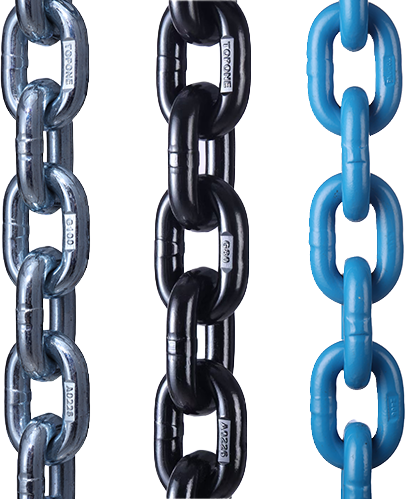
Direct chain lashing is generally suited to heavy tracked and wheeled machinery. Alloy-steel chain should have welded, heat-treated and proof-tested links with traceable grade and size. Hooks, links, binders and anchors must be compatible because the weakest component limits assembly WLL.
Use binders according to their instructions, prevent unintended release and never use an improvised extension handle. Web lashings can protect painted parts when edge, heat and abrasion risks are controlled, but do not replace required chains.
Design with Verifiable Numbers
Rules vary by jurisdiction. In the United States, 49 CFR §393.130 applies to wheeled or tracked machinery weighing at least 4,536 kg (10,000 lb). It requires at least four tiedowns near the front and rear or at purpose-designed points, with accessories lowered and articulation restrained. Section 393.102 applies separate breaking-strength criteria of 0.8 g forward and 0.5 g rearward and lateral.
For a hypothetical 30,000 kg excavator, the U.S. §393.106 aggregate-WLL threshold is about 147 kN or 33,100 lbf. Each direct trailer-to-machine tiedown contributes half its WLL; with four equal chains, each must be at least 16,535 lbf WLL for this threshold alone. Direction, angle, anchor strength and manufacturer instructions require separate checks.
Chain angle reduces effective restraint. If α is elevation from the deck and β is plan angle from the vehicle axis, the longitudinal component is T × cos α × cos β. At α = 30° and β = 20°, it is about 0.814T.
Installation and Inspection
Arrange independent chain legs in opposing directions and use rated points only. Keep chains straight, seat hooks fully, avoid side-loading and secure binder handles. Reject cracked, bent, stretched or severely corroded links, distorted hooks, damaged binders and items without identifiable WLL. Do not use uncontrolled heating or welding for repairs.
For U.S. operations covered by §392.9, inspect within the first 50 miles and again after a duty-status change, three hours or 150 miles, whichever occurs first. Multi-site fleets should record pre-use checks and quarantine damaged equipment.
Documented Lesson
In the 2000 NTSB Intercession City case, an 82-ton condenser with about 8 in ground clearance lodged at a railway crossing. It was not a lashing failure, but demonstrates the need for route and breakover assessment and railway coordination.
TOPONE supplies compatible cargo-control components and application support for restraint systems based on verified load data.