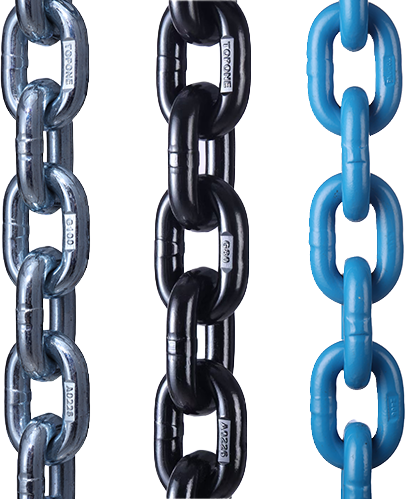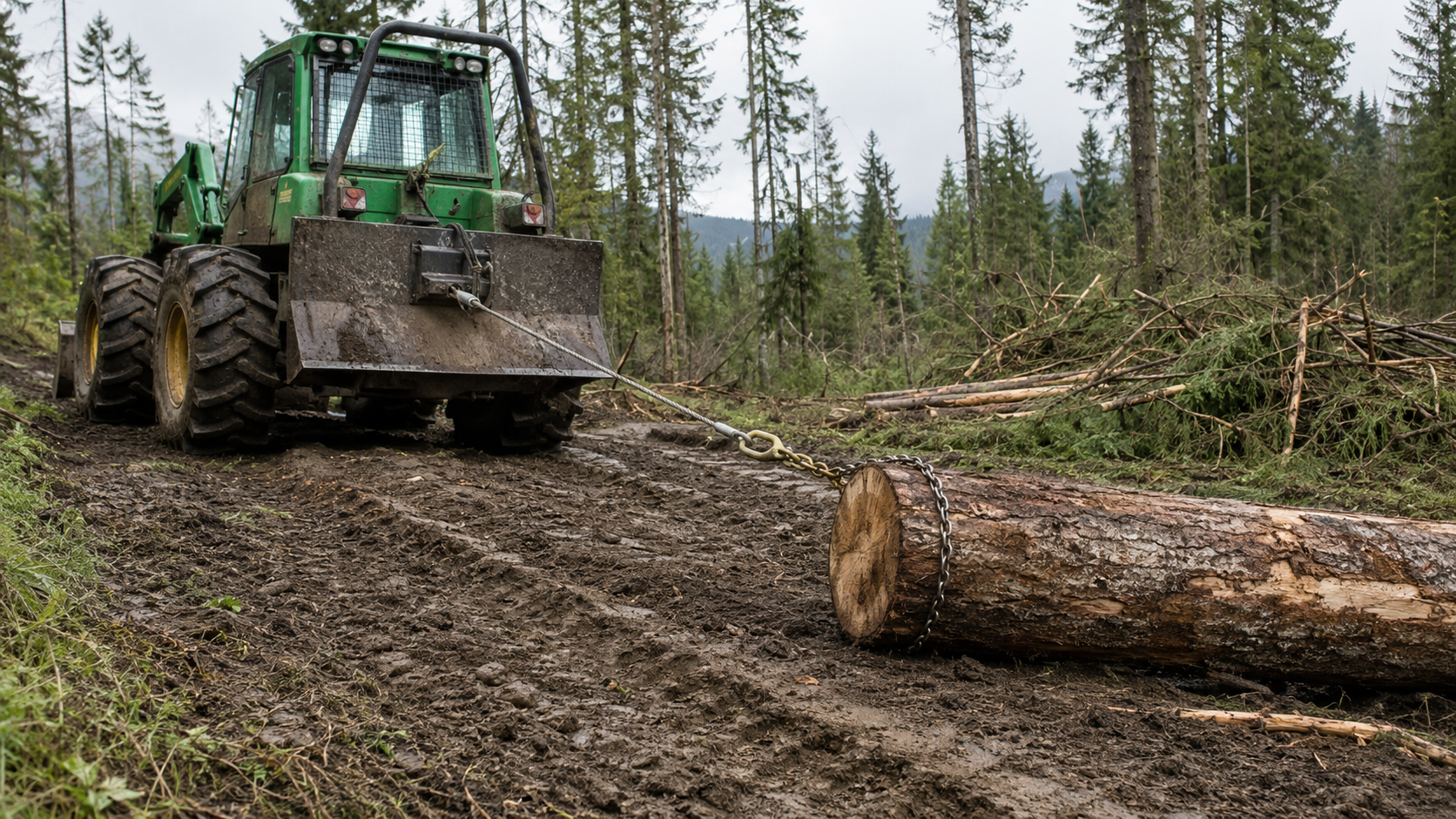
Forestry skidding moves felled trees and logs from cutting areas to landings by tractor winch, skidder or similar equipment. Chokers operate in mud, abrasive bark, stones, steep ground and restricted routes while experiencing repeated starts and temporary obstruction.
Typical Applications
Log skidding operations
Tree extraction systems
Forestry towing
Timber pulling systems
Heavy woodland transport
How the Choker System Works
A choker encircles the end of a log. Its free end passes through a choker hook, ring or sliding fitting and connects to the winch mainline, skidding arch or approved towing point. Pulling tension closes the choker around the log.
Chain chokers provide compact steel restraint where bark, soil and stone contact create abrasion. Wire-rope chokers are more flexible but require inspection for broken wires, kinks, crushing and termination damage. These systems are not interchangeable without recalculation.
Chain diameter, pitch, internal width and link profile must match the choker hook. Incorrect seating can concentrate load or allow release. Improvised bolts, field-welded attachments and unverified connectors are unacceptable.
Match Choker, Winch and Machine
ISO 19472:2006, confirmed current in 2026, covers forestry winches fitted to skidders, forwarders and agricultural tractors used for skidding. It excludes hoisting and cable-yarding systems and must not be cited outside that scope.
Confirm rated winch pull, rope diameter, fairlead alignment, choker working force, hook capacity, anchor strength and machine stability. Side pulling must remain within the machine manufacturer’s permitted angle. A redirect pulley changes line direction and anchor reaction; it does not automatically provide safe mechanical advantage.
A transport chain marked G70 may be used only when the complete choker manufacturer approves it for forestry pulling. Transport-chain working load data do not verify choker-hook compatibility or shock loading. A skidding choker is not automatically suitable for overhead lifting, vehicle recovery or cargo lashing.
Materials and Manufacturing
Purpose-made welded chain requires controlled forming, welding, heat treatment and calibration. Hooks and sliders require a verified component specification. Inspection, mechanical testing, permanent identification and batch traceability support consistent assembly strength.
The chain, hook, slider and connector form one system limited by its weakest component. Do not bend, drill, weld, grind or recoat a completed choker without written manufacturer approval. Coatings delay external corrosion but cannot prevent interlink and hook-contact wear.
Hypothetical Skidding-Pull Check
Preliminary uphill pull can be estimated by:
F = K × m × g × (μ × cos θ + sin θ)
Hypothetical inputs:
Log mass = 2,500 kg
Ground-drag coefficient μ = 0.45
Slope angle θ = 15°
Starting and impact factor K = 1.5
F = 1.5 × 2,500 × 9.81 × (0.45 × cos 15° + sin 15°)
F ≈ 25.5 kN
This is an estimated working pull, not a breaking force or product rating. Soil suction, branches, stumps, multiple logs and side pull can increase the load. The lowest-rated chain, hook, rope, pulley, anchor or winch component must satisfy the final requirement under applicable manufacturer and jurisdictional rules.
Inspection and Safe Operation
Before use and after a severe shock or hang-up, inspect load-bearing areas. Remove the chain according to manufacturer criteria for cracks, bent or twisted links, weld damage, deep gouges, heat damage, excessive corrosion, dimensional wear or an opened hook. Check wire rope for broken wires, kinks, birdcaging, crushing, corrosion and damaged ferrules.
No person should stand inside the bight of a line or in the predicted path of a rolling log, broken line or displaced debris. Stop the winch, secure the machine and release tension before clearing an obstruction. Repeated jerking is not a controlled method for releasing a hang-up.
In the United States, OSHA 29 CFR 1910.266 requires workers to be clear before a log moves. Chokers must be positioned near the log end and normally connected from the uphill side. If downhill access is unavoidable, the log must be securely chocked. Local forestry rules and machine instructions remain controlling.
TOPONE supplies matched forestry choker chains, hooks and connecting components based on verified winch pull, log conditions and operating geometry.